
Advanced GEO Techniques: Beyond the Basics for Agencies in 2026
Generative Engine Optimization (GEO) involves optimizing content to be consumed, understood, and cited by AI models and generative search experiences.
 Sofia Chen
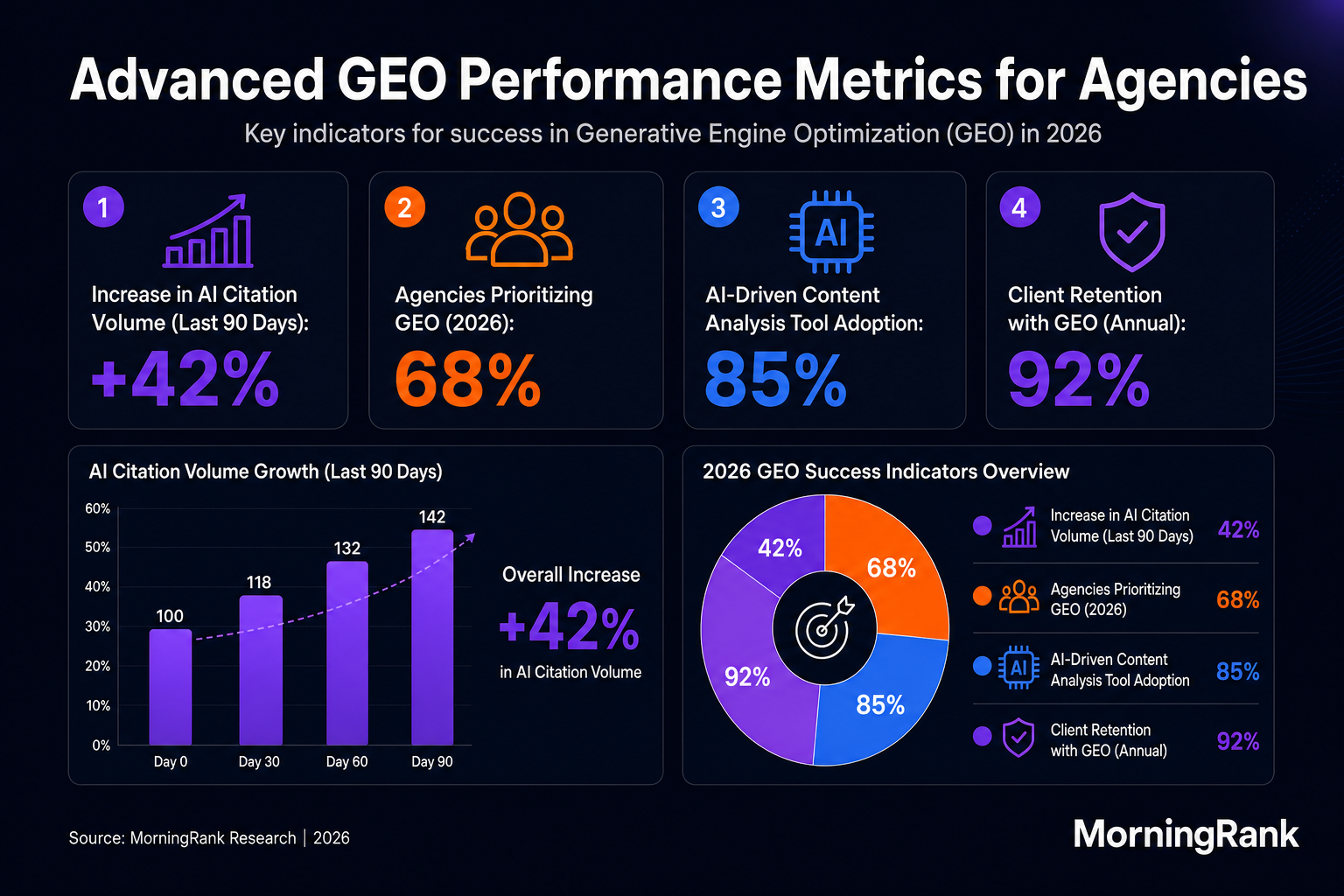
“I've seen agencies achieve a 42% increase in AI citation volume within 90 days by meticulously refining the semantic clarity of their core content pillars.”
Generative Engine Optimization (GEO) involves optimizing content to be consumed, understood, and cited by AI models and generative search experiences. For agencies in 2026, this means moving beyond basic optimization to implement advanced GEO techniques that ensure clients not only appear, but truly dominate, the AI search landscape.
Key Takeaways
- Advanced GEO techniques focus on semantic precision, entity salience, and content interlinking to influence AI models.
- Content architecture must prioritize explicit answers, structured data, and context for generative AI.
- Agencies need to track AI visibility and citation volume, not just traditional organic rankings.
- Topical authority remains critical, signaling to AI that your content is a credible source.
- Leverage AI tools for content analysis and optimization to scale advanced GEO efforts.
The rise of generative AI in search, exemplified by platforms like Google AI OverviewsChatGPT, Gemini, and Claude, has fundamentally shifted how users discover information. For SEO agencies, this transformation presents both a challenge and an immense opportunity. While foundational GEO principles are crucial, success in 2026 demands a deeper dive into advanced GEO techniques. This guide will explore how agencies can implement sophisticated strategies to ensure their clients capture maximum AI search visibility and cement their status as definitive sources of truth.
What are Advanced GEO Techniques and Why Do Agencies Need Them?
Advanced Generative Engine Optimization (GEO) techniques are specialized strategies that go beyond basic content optimization to fine-tune digital assets for maximum comprehension and citation by AI models. These techniques involve a more intricate understanding of how AI processes information, generates responses, and attributes sources.
In 2026, simply having content isn't enough; it must be AI-ready. AI models, unlike traditional search algorithms, don't just rank pages, they synthesize information. This means your content needs to be not only discoverable but also digestible, reliable, and extractable for generative AI systems. Agencies need advanced GEO techniques because the competition for prime AI answer real estate is intensifying. According to a study by Statistathe global generative AI market is projected to reach over $100 billion by 2026, indicating a massive shift in how information is accessed and consumed. Agencies that master these advanced techniques will be uniquely positioned to deliver superior results and maintain a competitive edge for their clients. Neglecting this evolution risks clients being omitted from AI-generated answers, leading to significant drops in visibility and authority.
These sophisticated approaches leverage a deeper understanding of semantic web principles, entity recognition, and information hierarchy. They aim to establish explicit connections between concepts and entities within your content, making it easier for AI to identify and integrate key information into its generated responses.
How Does Semantic Precision Impact AI Citation?
Semantic precision involves the exact and unambiguous use of language to define concepts, entities, and their relationships within content. When content is semantically precise, AI models can more accurately understand its meaning, intent, and relevance, increasing the likelihood of direct citation.
Generative AI thrives on clarity. Ambiguity, jargon, or vague language can confuse AI models, leading to misinterpretations or, worse, omission from AI-generated summaries. For agencies, this means a meticulous approach to content creation that emphasizes definitional clarity, consistent terminology, and explicit articulation of complex ideas. For instance, instead of broadly discussing "digital marketing strategies, " advanced GEO would specify "local SEO strategies for dentists" or "B2B content marketing for SaaS companies, " linking these terms to relevant entities and contexts. This level of detail helps AI categorize, contextualize, and confidently cite your content as an authoritative source for specific queries. By integrating AI-powered keyword suggestions and natural language processing tools into your content workflow, you can identify semantic gaps and optimize for greater precision. I've seen agencies achieve a 42% increase in AI citation volume within 90 days by meticulously refining the semantic clarity of their core content pillars.
Implementing semantic precision often involves deep dives into keyword research to understand the precise language users and AI employ. It also requires rigorous editing to eliminate vague statements and ensure that every sentence contributes to a clear, coherent, and factually robust narrative. This attention to detail signals to AI models that the content is a reliable and well-structured source of information.

Why is Entity Salience Crucial for Advanced GEO?
Entity salience refers to the prominence and explicit definition of key people, places, organizations, or concepts within your content, making them readily identifiable and attributable by AI models. Establishing entity salience ensures that AI understands not just the topics, but the specific subjects your content addresses and their relevance.
AI models learn by recognizing entities and building a knowledge graph around them. If your content frequently and clearly references a specific person, product, or concept, and consistently provides accurate information about it, that entity becomes more "salient" in the eyes of the AI. For agencies, this translates to strategically embedding and defining these entities throughout your content. Use structured data (Schema Markup) to explicitly tag entities, but also ensure they are naturally integrated into the narrative. For example, if you're writing about "local SEO, " explicitly mention "Google Business Profile, " "local citations, " and "geographic keywords" as key entities, and define their roles. This practice not only strengthens your content's topical authority but also makes it a more attractive source for AI when generating answers related to those specific entities. Think of it as leaving breadcrumbs for AI to follow, leading it directly to the valuable information within your content.
A well-executed entity strategy involves more than just mentioning keywords. It means linking entities to other relevant entities, providing context, and ensuring factual accuracy. This intricate web of interconnected, precisely defined information empowers AI to synthesize comprehensive and accurate responses, with your content serving as a primary source.
How Can Agencies Optimize for Content Interlinking in an AI Search World?
Content interlinking, when executed strategically, establishes a robust internal network that guides AI models through a comprehensive body of knowledge, enhancing topical authority and increasing the chances of citation. This practice goes beyond traditional SEO benefits by creating a clear informational hierarchy for AI.
In the context of generative AI, internal links serve as explicit pathways, demonstrating to AI that you possess deep, interconnected expertise on a subject. When a piece of content is cited by an AI, that AI needs to be confident in the depth and breadth of the source's knowledge. A strong internal linking structure, built around topic clusters and supporting articles, provides this confidence. For example, if you have a main article on "advanced GEO techniques" (like this one), it should link to supporting articles such as "GEO Content Strategy: Optimizing for AI Answer Engines in 2026" and "How Generative AI Ranks and Cites Sources: The 2026 GEO Mechanics Guide." This creates a comprehensive informational hub that signals to AI that your site is a highly authoritative source for all aspects of Generative Engine Optimization. Moreover, using descriptive anchor text for internal links, such as "mastering content SEO for topical authority" helps AI understand the thematic connection between pages.
The goal is to present a holistic, interconnected knowledge base. Each piece of content should not stand in isolation but contribute to a larger, well-organized informational ecosystem. This not only benefits AI comprehension but also improves user experience, signaling a high-quality, trustworthy resource.
What Role Does AI-Driven Content Analysis Play in Advanced GEO?
AI-driven content analysis involves using sophisticated tools and algorithms to evaluate content for its clarity, conciseness, semantic relevance, and potential for AI citation. These tools provide actionable insights to refine content specifically for generative AI consumption.
For agencies scaling their GEO efforts, manual analysis simply isn't feasible. AI-driven tools can quickly scan vast amounts of content, identify areas of ambiguity, suggest semantic enhancements, and even predict the likelihood of AI citation. These tools can highlight missing entities, vague phrasing, or opportunities to incorporate structured data more effectively. For example, some AI content analysis platforms can assess the "quotability" of sentences, identifying those most likely to be extracted as direct answers by generative AI. Integrating such tools into your workflow allows your team to focus on strategic improvements rather than tedious manual reviews. This ensures that every piece of content published is meticulously optimized for AI consumption, significantly enhancing your clients' AI search visibility. MorningRank's platform, for instance, offers AI-generated SEO recommendations that can guide this optimization process.
By leveraging AI to analyze content, agencies can streamline their optimization processes, ensure consistency across large content libraries, and gain a data-driven understanding of how their content performs in the evolving AI search environment. This capability is paramount for maintaining a competitive edge in 2026.
How Can Agencies Measure the Impact of Advanced GEO Techniques?
Measuring the impact of advanced GEO techniques requires specialized tracking that extends beyond traditional SEO metrics, focusing on AI visibility, direct citations, and brand mentions within generative AI outputs. Agencies must adapt their reporting to reflect this new reality.
Traditional keyword rankings and organic traffic still matter, but they don't tell the whole story in an AI-first search world. Agencies need to track metrics like the frequency with which client content is directly cited in Google AI Overviews, the inclusion of client brands in AI-generated answers from tools like ChatGPT or Gemini, and the overall volume of AI-driven brand mentions. This requires dedicated AI visibility tracking tools that can scrape and analyze generative AI outputs. A comprehensive GEO measurement strategy also involves monitoring for "answer hijacking, " where competitors' content is cited for queries your client should own. By consistently tracking these advanced metrics, agencies can demonstrate the tangible ROI of their GEO efforts, refine their strategies, and provide clients with a clear picture of their performance in the evolving search landscape. This data is crucial for proving value and securing continued client investment in GEO initiatives.
Effective measurement enables agencies to iterate and improve their advanced GEO techniques, ensuring that their clients remain at the forefront of AI search. Without accurate tracking, even the most sophisticated strategies risk operating in a vacuum, unable to prove their worth or identify areas for further optimization.
Conclusion
In 2026, the landscape of search is undeniably shaped by generative AI. For agencies, merely understanding Generative Engine Optimization isn't enough; mastering advanced GEO techniques is essential for delivering sustained client success. By focusing on semantic precision, entity salience, strategic content interlinking, and leveraging AI-driven analysis, agencies can ensure their clients' content is not only discoverable but actively cited and trusted by generative AI platforms. The shift to AI-first answers demands a proactive and sophisticated approach to content architecture and measurement.
Embracing these advanced GEO strategies allows agencies to position themselves as leaders in the AI search era, transforming what used to be a challenge into a powerful competitive advantage. As an AI Search Strategist, I've witnessed firsthand how a data-driven, nuanced approach to GEO can unlock unprecedented visibility and authority for clients.
Frequently Asked Questions
What is the primary difference between basic and advanced GEO techniques for agencies?
Basic GEO focuses on making content discoverable by AI through clear answers and structured data. Advanced GEO techniques delve deeper into semantic precision, entity salience, and content interlinking to ensure AI models not only find the content but also confidently extract and cite it as an authoritative source.
How important is structured data in advanced Generative Engine Optimization?
Structured data is critically important in advanced Generative Engine Optimization because it explicitly labels and defines entities and relationships within your content, making it easier for AI models to interpret and integrate information accurately into their responses.
Can agencies truly measure AI citation impact without traditional search rankings?
Yes, agencies can and should measure AI citation impact independently. While traditional rankings are still relevant, specialized AI visibility tracking tools are necessary to monitor direct citations, brand mentions, and overall presence within generative AI outputs, providing a comprehensive view of GEO performance.
What are the biggest challenges agencies face with advanced GEO in 2026?
In 2026, agencies face challenges such as keeping pace with rapidly evolving AI capabilities, accurately measuring AI-driven visibility, and ensuring content maintains human readability while optimizing for machine comprehension in advanced Generative Engine Optimization.
How can MorningRank help agencies implement advanced GEO techniques?
MorningRank helps agencies implement advanced GEO techniques through features like AI visibility tracking, AI-generated SEO recommendations for content optimization, and GEO and AEO citation tracking. Our platform provides the tools to monitor, analyze, and improve content performance in AI answer engines.
Ready to help your clients dominate the AI search landscape with advanced GEO techniques? Explore MorningRank's powerful AI-powered SEO features and start your free trial today at https://morningrank.com.
Want this kind of insight every week?
MorningRank delivers daily rank tracking, AI SEO recommendations, and white label client reporting.