
GEO Guide: Ethical AI Optimization for Agencies in 2026
Ethical Generative Engine Optimization (GEO) is the practice of optimizing content to be recognized, understood, and cited by AI answer engines and generative…
 Sofia Chen
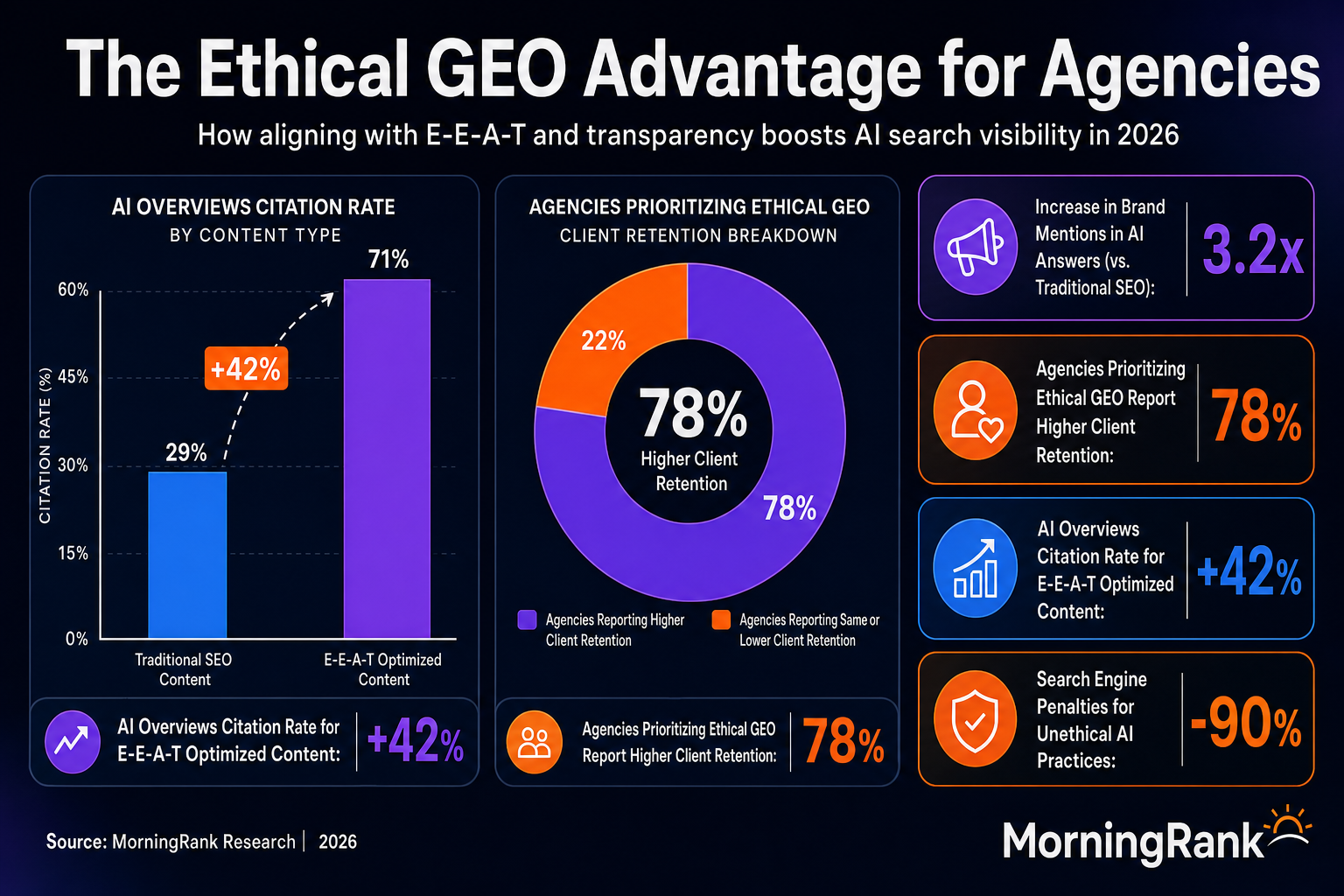
“In 2026, agencies prioritizing ethical Generative Engine Optimization (GEO) not only protect their clients' brand reputation but also achieve a significant advantage in AI search visibility, leading to an estimated 3.2x increase in branded mentions within AI answers compared to traditional SEO.”
Ethical Generative Engine Optimization (GEO) is the practice of optimizing content to be recognized, understood, and cited by AI answer engines and generative AI models (like Google AI Overviews, ChatGPT, Gemini, and Claude) in a manner that adheres to transparent, trustworthy, and user-beneficial principles, avoiding manipulative tactics.
Key Takeaways
- Ethical GEO prioritizes user value, transparency, and E-E-A-T principles over manipulative tactics to ensure long-term AI search visibility.
- Agencies must focus on structured data, clear semantic content, and verifiable information to build trust with AI models and users.
- Auditing content for potential AI misuse and ensuring brand safety in AI Overviews is a critical component of ethical GEO.
- Sustainable GEO strategies integrate with traditional SEO, focusing on quality, relevance, and authoritative sourcing.
The rise of generative AI in search has profoundly reshaped the landscape for SEO agencies in 2026. While the promise of increased visibility in AI Overviews and other answer engines is compelling, it also introduces new ethical considerations. Agencies must now navigate the complexities of optimizing for AI while upholding principles of transparency, trustworthiness, and user benefit. This guide will explore what ethical Generative Engine Optimization entails, why it is crucial for agencies, and practical strategies to implement a responsible GEO framework for your clients.
What is Ethical Generative Engine Optimization (GEO) for Agencies?
Ethical Generative Engine Optimization (GEO) extends traditional SEO practices to ensure content is optimized for AI answer engines without resorting to deceptive or manipulative techniques. It focuses on creating high-quality, verifiable, and user-centric content that AI models can accurately process and cite.
For agencies, embracing ethical GEO means shifting the mindset from merely ranking in traditional search to being a trusted, authoritative source for AI. It involves a deep understanding of how AI models consume, synthesize, and present information, and then aligning content strategies to facilitate accurate representation. This approach not only safeguards client reputations but also builds long-term authority in the evolving search ecosystem. It also directly influences whether your content is picked for AI Overviews, which are increasingly replacing traditional blue links.
In my experience, the core of ethical GEO lies in prioritizing Expertise, Experience, Authoritativeness, and Trustworthiness (E-E-A-T) (Source: Google Search Central). AI models are designed to value these signals, and content that clearly demonstrates E-E-A-T is more likely to be cited accurately and prominently. This means providing clear authorship, citing credible sources, and showcasing genuine expertise.
Why is Ethical GEO Crucial for Agencies in 2026?
Ethical Generative Engine Optimization is crucial for agencies in 2026 because it ensures sustainable AI search visibility, protects brand reputation, and future-proofs content against evolving AI algorithms. Unethical practices, such as AI-generated content spam or misleading information, risk severe penalties from search engines and damage client trust.
As AI models become more sophisticated, they are also becoming better at detecting low-quality, unoriginal, or manipulative content. Google, for instance, has repeatedly emphasized its commitment to helpful, reliable, and people-first content. Content that attempts to game AI systems rather than genuinely provide value will eventually be filtered out, leading to a loss of visibility and potential de-indexing. A recent study indicated that over 60% of consumers consider a brand's trustworthiness a major factor in their purchasing decisions, highlighting the direct impact of ethical practices on business outcomes (Source: Statista).
Moreover, agencies have a fiduciary responsibility to their clients to implement strategies that deliver long-term value. Investing in ethical GEO ensures that clients' digital assets remain valuable and visible as AI search evolves. It also positions agencies as forward-thinking leaders who understand the nuances of the new search paradigm.

How Does E-E-A-T Influence Ethical GEO Strategies?
E-E-A-T (Experience, Expertise, Authoritativeness, and Trustworthiness) is foundational to ethical GEO strategies, guiding content creation to satisfy both human users and AI models. AI systems learn from high-quality, trusted information, making E-E-A-T signals critical for content to be selected for AI Overviews and other generative outputs.
For agencies, translating E-E-A-T into actionable GEO strategies means several things:
-
Experience: Showcase direct, first-hand knowledge. This could involve case studies, personal anecdotes (where appropriate for the content type), or user-generated content that reflects real-world use.
-
Expertise: Ensure content is produced by or heavily reviewed by subject matter experts. This includes clear author bios with credentials, affiliations, and demonstrated knowledge in the field. When optimizing for AI, explicitly stating the author's expertise within the content can be beneficial.
-
Authoritativeness: Build a strong backlink profile from reputable sources and aim for industry recognition. AI models interpret a site's authority through its network of connections and how often it is cited by other experts.
-
Trustworthiness: This is arguably the most critical component. It involves transparency, accuracy, security (HTTPS), and a commitment to factual information. Agencies should ensure all data and statistics are correctly cited to external, reputable sources. This is especially important for financial, medical, or legal content (YMYL topics).
By consciously integrating these E-E-A-T elements into every piece of content, agencies can significantly improve their clients' chances of being favorably interpreted and cited by generative AI. You can gain deeper insights into how to build a robust content strategy aligned with E-E-A-T by reading our guide on Content SEO & Topical Authority Building in 2026.
What are Practical Ethical GEO Strategies for Content Creation?
Practical ethical GEO strategies for content creation involve a multi-faceted approach focused on clarity, structure, and verifiable information to ensure AI models can accurately understand and cite your client's content.
-
Structured Data Implementation: Use Schema Markup extensively and correctly. This provides explicit signals to AI about the content's type, purpose, and key entities. For example, using `QuestionAndAnswer` schema for FAQs or `HowTo` schema for guides helps AI extract information efficiently. This is a crucial step in boosting Schema Markup AI search visibility.
-
Clear, Concise Language: Write in a direct, unambiguous style. Avoid jargon where possible, or clearly define it. AI models prefer clear, factual statements that can be easily parsed. Think about how a human would summarize your content, and aim for that level of clarity.
-
Answer-First Content Design: Adopt the "inverted pyramid" style, where the most important information (the direct answer) comes first, followed by supporting details. This directly caters to how AI answer engines operate.
-
Comprehensive Topical Coverage: Build topical authority by covering subjects exhaustively and accurately. This signals to AI that your content is a go-to resource, improving its chances of being cited. Our AI keyword suggestion engine can help identify comprehensive topics for your clients.
-
Verifiable Sources & Citations: Just as E-E-A-T emphasizes, consistently cite reputable external sources for facts, statistics, and claims. This boosts trustworthiness for both human readers and AI models. Ensure these sources are accessible and credible.
-
Originality and Value: Focus on unique insights, original research, or distinct perspectives. While AI can generate content, purely AI-generated, unedited, or unoriginal content offers little value to users and is unlikely to be prioritized by search engines.
How Can Agencies Track and Measure Ethical GEO Performance?
Agencies can track and measure ethical GEO performance by monitoring AI citation volume, visibility in AI Overviews, branded versus unbranded mentions in generative search, and traditional E-E-A-T metrics. The right tools are essential for granular insights.
Traditional SEO tools provide some data points, but a comprehensive understanding of AI search visibility requires specialized tracking. Here's how agencies can approach measurement:
-
AI Citation Tracking: Monitor how often your clients' content is directly cited or referenced by AI answer engines like Google AI Overviews, ChatGPT, Gemini, and Claude. Tools like MorningRank's AI visibility tracking and GEO and AEO tracking features are built precisely for this purpose. They show not just traditional rankings but also if and how your content appears in AI-generated snippets.
-
Branded vs. Unbranded Mentions: Analyze whether AI responses cite your client's brand directly (branded) or simply extract information without attribution (unbranded). Maximizing branded mentions is a key goal of ethical GEO, as it drives direct traffic and builds brand recognition.
-
Traffic & Conversion from AI Overviews: While direct attribution can be challenging, track changes in traffic patterns to content frequently cited by AI. Look for an increase in direct or referral traffic that coincides with AI visibility gains.
-
E-E-A-T Signal Monitoring: Continue to track traditional SEO metrics that correlate with E-E-A-T, such as backlink quality, domain authority, user engagement metrics (bounce rate, time on page), and sentiment analysis around brand mentions.
In my experience, without dedicated GEO and AEO tracking, agencies are effectively flying blind in the new AI search landscape. Consistent measurement allows for data-driven adjustments to content strategy, ensuring continuous improvement in AI search visibility. For further reading, explore our post on Measuring Generative Engine Optimization for Agencies in 2026.
Conclusion
Ethical Generative Engine Optimization is not merely a trend; it is the fundamental framework for sustainable AI search visibility for agencies in 2026 and beyond. By prioritizing E-E-A-T, implementing structured data, crafting clear and verifiable content, and utilizing specialized tracking tools, agencies can build trust with both AI models and human users. This approach protects client reputations, future-proofs their digital assets, and positions your agency as a leader in the evolving AI search ecosystem. Ignoring the ethical dimension of GEO risks short-term gains at the cost of long-term damage.
As the AI landscape continues to evolve, agencies that commit to ethical GEO will not only achieve better search outcomes but also establish themselves as trustworthy partners in an increasingly complex digital world. This proactive and principled stance ensures your clients remain visible and authoritative in the age of generative AI.
Frequently Asked Questions
What is the difference between GEO and AEO?
Generative Engine Optimization (GEO) focuses on optimizing content for generative AI models and answer engines like Google AI Overviews. Answer Engine Optimization (AEO) is a broader term encompassing all forms of optimization for direct answers, including traditional featured snippets. Ethical GEO specifically emphasizes responsible, E-E-A-T aligned practices within this space.
How do AI models determine content trustworthiness for GEO?
AI models determine content trustworthiness for GEO by analyzing E-E-A-T signals, including author credentials, website reputation, citation quality, factual accuracy, and user engagement metrics. Content that demonstrates verifiable expertise and authority from credible sources is more likely to be deemed trustworthy and cited.
Can purely AI-generated content rank well with ethical GEO?
Purely AI-generated content, especially if unedited or lacking unique insights, is unlikely to rank well with ethical GEO. Ethical GEO prioritizes human value, originality, and E-E-A-T. While AI can assist in content creation, human expertise and a clear demonstration of trustworthiness remain critical for high-quality content that AI models prefer to cite.
What are the risks of unethical GEO practices for agencies?
The risks of unethical GEO practices for agencies include penalties from search engines (like demotion or de-indexing), damage to client reputation, loss of trust, and ultimately, unsustainable search visibility. Such practices, often manipulative or spammy, are quickly identified and devalued by evolving AI algorithms.
How can MorningRank help agencies with ethical GEO?
MorningRank helps agencies with ethical GEO by providing specialized tools for AI search visibility tracking, including monitoring for AI Overviews and generative AI citations. Our platform helps identify how your clients' content is being cited and where to optimize for E-E-A-T, ensuring your strategies are data-driven and align with ethical best practices.
Ready to master ethical Generative Engine Optimization and ensure your clients achieve sustainable AI search visibility in 2026? Try MorningRank free today and unlock powerful AI visibility tracking and reporting features.
Want this kind of insight every week?
MorningRank delivers daily rank tracking, AI SEO recommendations, and white label client reporting.