
Client Reporting Best Practices for Agencies in 2026
In the competitive agency landscape of 2026, simply delivering results isn't enough.
 Marcus Rivera
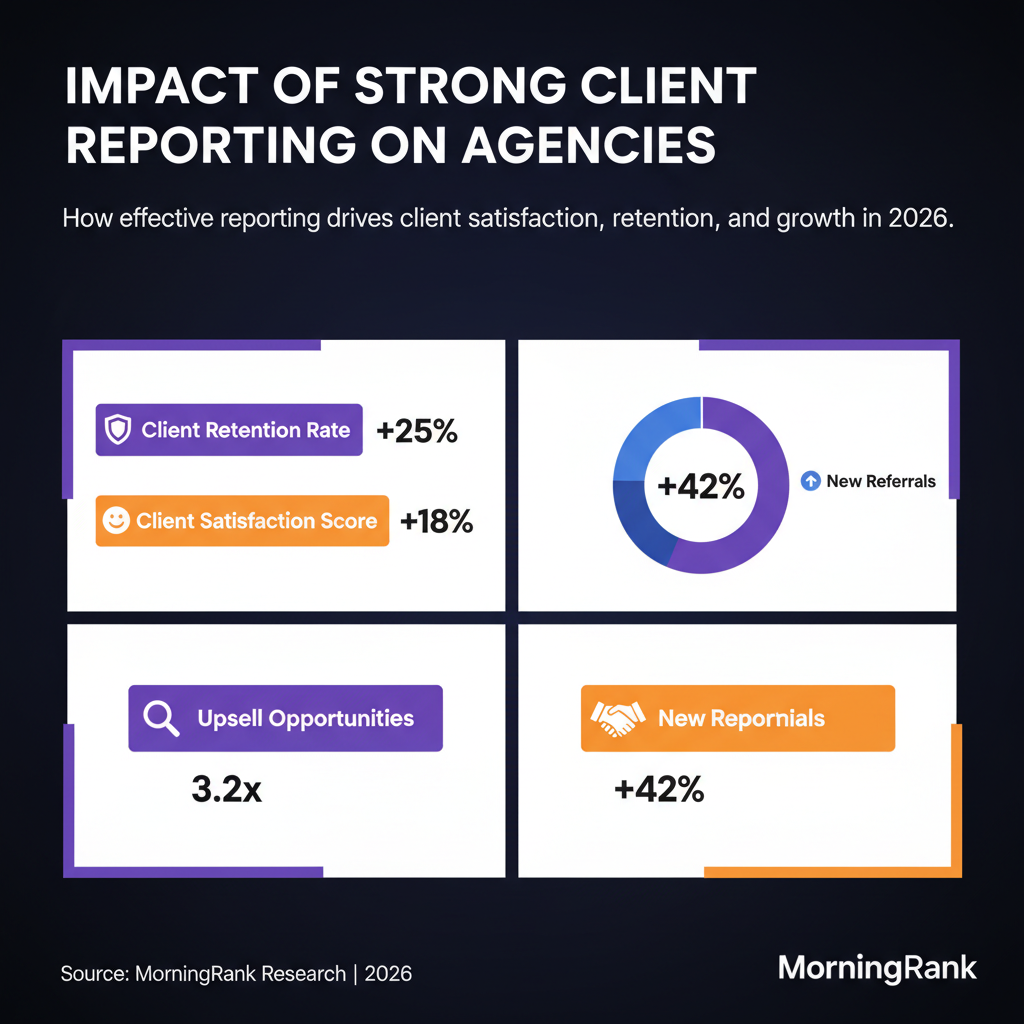
“In 2026, agencies that excel at client reporting see, on average, a 25% higher client retention rate compared to those with generic, infrequent updates. The demonstrable ROI of transparent communication is undeniable.”
In the competitive agency landscape of 2026, simply delivering results isn't enough. Agencies must effectively communicate those results to retain clients and foster long-term partnerships. As an Agency Growth Strategist at MorningRank, I've witnessed firsthand how impactful excellent client reporting best practices can be. Transparent, data-driven reports are the bedrock of trust, demonstrating undeniable value and justifying your agency's fees.
Many agencies struggle with client reporting, often due to time constraints or a lack of understanding about what clients truly want to see. Clients aren't just paying for rankings; they're investing in growth, visibility, and ultimately, a healthier bottom line. Your reports need to connect your SEO efforts directly to those business objectives, cutting through the jargon to reveal tangible progress and future opportunities. In this comprehensive guide, we'll dive deep into best practices that will transform your client reporting from a mundane task into a powerful client retention tool.
Understand Your Client's Business Goals and KPIs
Effective client reporting begins long before you hit "send" on an email. It starts with a comprehensive understanding of your client's overarching business objectives and how those translate into measurable Key Performance Indicators (KPIs). Without this foundational knowledge, your reports risk becoming a generic list of SEO metrics that fail to resonate with the client's primary concerns. In my experience, the biggest mistake agencies make is reporting on vanity metrics rather than impact metrics.
During client onboarding, dedicate significant time to discussing their business goals. Are they aiming for increased brand awareness, more leads, higher e-commerce sales, or improved ROI from marketing spend? Once these goals are clear, work collaboratively to identify the specific SEO KPIs that directly contribute to those objectives. For instance, if a client wants more leads, you might track organic traffic to landing pages, conversion rates on those pages, and lead form submissions. If their goal is e-commerce sales, metrics like organic revenue, transaction volume, and average order value become paramount. This strategic alignment ensures that every report speaks directly to what matters most to them.
Aligning SEO Metrics with Business Outcomes
It's crucial to bridge the gap between technical SEO metrics and their business implications. For example, while improved keyword rankings are important, a client ultimately cares about the traffic those rankings bring and the conversions that traffic generates. Similarly, a decrease in page load time (a technical metric) isn't exciting on its own; what matters is how it impacts user experience, bounce rates, and ultimately, lead generation or sales.
A good report translates these technical achievements into business language. Clearly explain how a 15% increase in organic traffic (an SEO metric) led to a 10% rise in qualified leads (a business outcome). Always emphasize the "so what" behind each data point. This approach not! only educates your client but also reinforces your agency's value as a strategic partner, not just a service provider. For more on tracking specific metrics, refer to our guide on Mastering Keyword Rank Tracking Strategies for Agencies in 2026.
Setting Realistic Expectations
Transparency extends to setting realistic expectations from the outset. SEO is a long-term strategy, and significant results rarely happen overnight. Discuss potential timelines for different types of improvements, clearly explaining the factors that can influence success, such as competition, website health, and budget. When reporting, acknowledge both successes and challenges. If a particular strategy isn't yielding the expected results, explain why, what you've learned, and what adjustments you plan to make. This proactive communication builds trust and demonstrates your agency's commitment to continuous improvement. In my experience, clients appreciate honesty far more than sugar-coating.
For instance, if a client has a highly competitive keyword target, explain that achieving top rankings might take longer than for a niche query. Regularly review and adjust these expectations as campaigns progress, using data to inform your conversations. This level of communication differentiates effective agencies from those that merely send automated reports.
Crafting Clear, Concise, and Actionable Reports
Once you understand your client's goals, the next step is to present the data in a way that is both clear and actionable. Overly complex or jargon-filled reports can confuse clients and undermine your efforts. The goal is to distill vast amounts of data into an easily digestible narrative that highlights progress, identifies key insights, and outlines next steps.
Think of your report as a story, not just a spreadsheet. Begin with an executive summary that quickly outlines the most important achievements and challenges, followed by detailed sections for each key area of your SEO work. Visualizations, such as charts, graphs, and tables, are invaluable for making data understandable at a glance. Avoid overwhelming clients with too much information; focus on the metrics that directly align with their previously established KPIs.
The Power of Visualizations and Executive Summaries
An executive summary is perhaps the most crucial part of your report. It provides a high-level overview of performance, key takeaways, and strategic recommendations, all designed to be consumed quickly by busy stakeholders. In my agency audits, I often find clients skipping detailed sections altogether if the executive summary isn't compelling.
Visualizations, such as line graphs for rank changes, bar charts for traffic sources, or pie charts for conversion breakdowns, make complex data immediately accessible. Tools like MorningRank allow you to integrate these visuals seamlessly into automated PDF reports. When comparing your progress to competitors, a well-structured table can be highly effective. Consider the following example for demonstrating competitor performance:
| Metric | Your Client | Competitor A | Competitor B |
|---|---|---|---|
| Organic Traffic (monthly) | 15,200 | 18,500 | 12,800 |
| Top 3 Organic Keywords | 85 | 110 | 70 |
| Avg. Keyword Position | #7.2 | #5.9 | #8.1 |
| Number of Referring Domains | 240 | 310 | 190 |
Remember, the goal of these visuals is to provide insights, not just data dumps. Ensure each chart or graph is clearly labeled and accompanied by a brief explanation of what it shows and why it's important.
Providing Actionable Insights and Next Steps
A report that simply states "Traffic is up" or "Rankings decreased" isn't useful. Clients want to know *why* these changes occurred and *what your agency plans to do about it*. Each section of your report should include actionable insights and clear next steps.
- Insights: Explain the significance of the data. "The 20% increase in organic traffic to the new product page suggests a strong interest in this offering, validating our content strategy."
- Recommendations: Based on the insights, suggest specific actions. "We recommend further optimizing the product page for related long-tail keywords and developing a series of blog posts to capture additional audience segments."
- Next Steps: Outline the concrete actions your team will take in the upcoming reporting period. "Our team will conduct comprehensive keyword research for the new product, develop a content calendar for three supporting blog posts, and implement on-page optimizations by [Date]."
This approach demonstrates your agency's strategic thinking and proactive problem-solving capabilities. It shows clients that you're not just reporting on the past but actively planning for future growth. Always present challenges as opportunities for improvement, outlining your proposed solutions clearly.
Choose the Right Reporting Frequency and Channels
The cadence and delivery method of your reports are just as important as their content. Sending reports too frequently can overwhelm clients, while sending them too infrequently can leave them feeling out of the loop. Similarly, the channel you use for communication should match the client's preferences and the complexity of the information being conveyed.
Most agencies find a monthly reporting schedule to be ideal for SEO, as it allows enough time for measurable changes to occur while still providing regular updates. However, for campaigns with aggressive goals or during critical launch phases, bi-weekly or even weekly check-ins might be necessary. Conversely, for established, stable campaigns, quarterly deep-dive reports might suffice, supplemented by monthly executive summaries.
Tailoring Frequency to Client Needs
During onboarding, discuss and agree upon a reporting frequency with your client. Ask them about their preferred level of detail and how often they'd like to be updated. Some clients prefer a detailed monthly report and a quick bi-weekly email update, while others might only want a comprehensive quarterly review meeting. Flexibility is key here.
Consider the client's internal structures. Are they a small business owner who needs to quickly grasp the bottom line, or are they part of a larger marketing team that requires granular data for internal presentations? Tailoring the frequency and depth of your reports to these specific needs will significantly improve client satisfaction.
Leveraging Various Communication Channels
While the detailed performance report might be a PDF or an interactive dashboard, don't limit your communication to just that. Leverage various channels for different aspects of client communication:
- Automated PDF Reports/Dashboards: Ideal for comprehensive monthly or quarterly performance overviews, providing data visualizations and detailed breakdowns. Tools like MorningRank excel at generating these efficiently.
- Email Summaries: Perfect for quick bi-weekly updates, sharing a few key wins, or providing a heads-up about upcoming initiatives. Keep these concise and focused.
- Video Walkthroughs: For complex reports or new clients, recording a short video explaining the report's highlights can be incredibly effective. It adds a personal touch and ensures clarity.
- Scheduled Review Meetings: These are vital. Whether monthly or quarterly, a face-to-face (or virtual) meeting allows for discussion, Q&A, and relationship building. This is where you can truly "sell" your story and demonstrate your value.
- Ad-hoc Communication: Don't wait for the next report if something significant happens – good or bad. Proactive communication builds trust and shows you're on top of things.
A multi-channel approach ensures that clients receive information in their preferred format at the most appropriate times, reinforcing your commitment to transparency and ongoing partnership.

Continuously Refine Your Reporting Process
Client reporting isn't a static task; it's an evolving process. What works well today might need adjustments tomorrow as client needs change, campaigns mature, or new technologies emerge. Successful agencies constantly seek feedback and proactively refine their reporting strategies.
After each reporting cycle, take a moment to reflect. Was the report well-received? Did the client have many questions, indicating a lack of clarity? Did they ask for data points you hadn't included? Use this internal assessment to identify areas for improvement. Share insights within your team to ensure consistency and improve collective reporting acumen.
Gathering Client Feedback
The most direct way to improve your reporting is to ask your clients for feedback. During review meetings, dedicate a few minutes to discussing the report itself. Ask questions like:
- "Was the report easy to understand?"
- "Did it provide the insights you were looking for?"
- "Is there any information you'd like to see more or less of?"
- "What could we do to make these reports even more valuable to you?"
Actively listen to their responses and, critically, implement their suggestions where feasible. This shows clients that their input is valued and that you are committed to delivering the best possible service. Remember, a report that fails to meet a client's needs is, in essence, a failed report.
Leveraging Reporting Tools and Automation
Manual reporting can be incredibly time-consuming and prone to error. Investing in robust SEO reporting tools like MorningRank not only automates data collection and visualization but also frees up your team to focus on analysis and strategy development, rather than data compilation.
Sophisticated tools allow for custom branding, templating, and the creation of interactive dashboards that clients can access anytime. Automation ensures consistency, reduces human error, and allows for more frequent and detailed reporting without increasing your team's workload. My experience has shown that agencies leveraging intelligent automation can dedicate up to 30% more time to strategic client work, directly impacting client success and retention.
By automating the mundane, you empower your team to focus on the truly valuable aspects of client reporting: deriving insights, crafting compelling narratives, and proposing innovative solutions. This strategic shift transforms reporting from a necessary chore into a powerful competitive advantage.
Frequently Asked Questions
What is the most important metric to include in a client report?
While many metrics are important, the most crucial one is the one that directly aligns with your client's primary business goal. If their goal is lead generation, then qualified leads or conversion rate becomes paramount. If it's e-commerce sales, then organic revenue and transaction volume are key. Always prioritize metrics that show a direct impact on their bottom line as established during your initial goal-setting discussions.
How often should I send reports to my clients?
Most agencies find monthly reports to be ideal for SEO campaigns, as this allows sufficient time for measurable progress while keeping clients regularly informed. However, this should be tailored to individual client needs and campaign phases. Some clients might prefer bi-weekly updates or quarterly deep dives, especially for mature campaigns. Always discuss and agree upon the frequency during client onboarding.
Should I include negative results or challenges in my reports?
Absolutely. Transparency is key to building trust. If a particular strategy isn't performing as expected, include it in your report. Explain why you think it happened, what you've learned from it, and what adjustments you plan to make. Presenting challenges as opportunities for improvement, accompanied by a clear action plan, demonstrates your agency's proactive problem-solving capabilities and commitment to continuous optimization.
What's the difference between vanity metrics and impact metrics?
Vanity metrics are easily tracked numbers that look good on the surface but don't necessarily reflect real business value (e.g., high keyword rankings for irrelevant terms, huge spikes in short-term traffic without conversions). Impact metrics, conversely, directly tie to your client's business objectives and bottom line (e.g., organic revenue, qualified leads generated, ROI from organic channels, reduced cost per acquisition). Always prioritize reporting on impact metrics.
Is it better to use automated reports or personalized reports?
The most effective approach often combines both. Automated tools are excellent for generating data-rich, visually appealing, and consistent reports quickly. However, these should always be supplemented by a personalized executive summary, unique insights, bespoke recommendations, and personal review meetings. The automation handles the data, while your team provides the strategic interpretation and human connection.
How can I make my reports less jargon-heavy?
Aim to translate all technical SEO terms into business language. Avoid acronyms without explanation. Explain the "so what" behind each technical metric by connecting it directly to its business implication. For instance, instead of just stating "Page speed improved by 1.5 seconds," explain "Improved page speed by 1.5 seconds, which contributed to a 5% reduction in bounce rate and a 3% increase in conversion rate on key landing pages." Use analogies if helpful and always assume your client is not an SEO expert.
What if my client doesn't seem to read the detailed reports?
This is a common challenge. If clients aren't engaging with detailed reports, condense the information. Focus heavily on a compelling executive summary that highlights only the most critical outcomes and next steps. Prioritize face-to-face (or virtual) review meetings where you can verbally walk them through the key takeaways. Consider interactive dashboards where they can easily filter for the information most relevant to them. The goal is to deliver information in a format and depth they will actually consume.
Mastering client reporting is an ongoing journey that requires a blend of strategic thinking, clear communication, and the intelligent use of technology. By understanding your client's goals, crafting actionable and transparent reports, optimizing your delivery channels, and continuously seeking feedback, your agency can transform reporting from a mere obligation into a powerful tool for client retention and growth. At MorningRank, we believe that exceptional reporting is not just about showing what you've done, but about proving your indispensable value to every single client, cementing partnerships that propel both their business and your agency forward for years to come. Start implementing these best practices today and watch your client relationships flourish!
Want this kind of insight every week?
MorningRank delivers daily rank tracking, AI SEO recommendations, and white label client reporting.