
Precision Keyword Rank Tracking: Best Practices for Agencies in 2026
Precision keyword rank tracking for agencies involves monitoring the search engine performance of specific keywords across various geographic locations and…
 Marcus Rivera
“In my experience, agencies that provide detailed, easily digestible reports based on precision rank tracking tend to retain clients longer, often outperforming competitors who rely on more generalized metrics.”
Precision keyword rank tracking for agencies involves monitoring the search engine performance of specific keywords across various geographic locations and SERP features. Implementing a robust keyword rank tracking strategy enables agencies to demonstrate ROI, fine-tune SEO tactics, and proactively respond to algorithmic shifts, ensuring sustained client growth.
Key Takeaways
- Effective keyword rank tracking requires meticulous selection of target keywords aligned with client goals and user intent.
- Agencies must monitor rankings at granular geographic levels for accurate local SEO performance insights.
- Beyond organic positions, tracking SERP features (like local packs and featured snippets) is crucial for comprehensive visibility analysis.
- Regularly analyzing competitor performance provides actionable intelligence for refining client strategies.
- Utilizing an advanced rank tracking tool with robust reporting capabilities is essential for agency efficiency and client satisfaction.
As an agency growth strategist at MorningRank, I've seen firsthand how challenging it can be to demonstrate tangible SEO value to clients. In 2026, the digital landscape is more competitive and dynamic than ever, with Google's algorithms constantly evolving and the rise of AI-powered search. Simply knowing where a keyword ranks on a national level is no longer enough. Agencies need precision, depth, and context in their keyword rank tracking strategies to truly understand performance and drive results for their clients. This guide will walk you through the essential components of a modern, effective keyword rank tracking strategy tailored for agency success.
Why is Precision Keyword Rank Tracking Critical for Agencies in 2026?
Precision keyword rank tracking is crucial for agencies because it provides the data necessary to make informed decisions, prove value, and adapt to a rapidly changing search environment. Without accurate and detailed ranking data, an agency is essentially flying blind, unable to definitively answer client questions about performance or explain fluctuations. This level of tracking is about accountability and insight.
How Does Granular Data Improve Client Reporting and Retention?
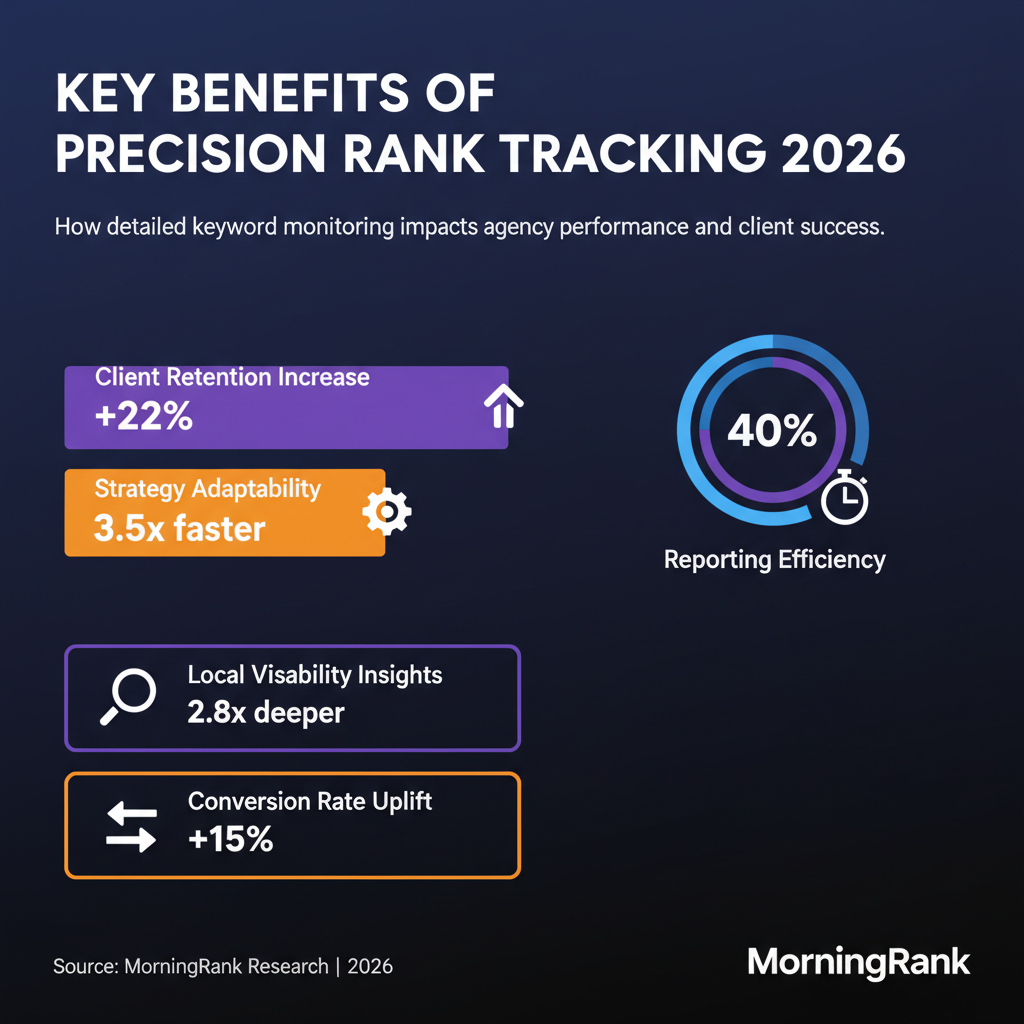
Granular data from keyword rank tracking directly enhances client reporting by offering specific, measurable insights into campaign performance. Instead of vague progress statements, agencies can show exact keyword movements, historical trends, and position changes within specific locations or SERP features. This transparency builds trust and strengthens client relationships, often leading to higher retention rates. Clients appreciate seeing their investment translate into clear, understandable metrics. In my experience, agencies that provide detailed, easily digestible reports based on precision rank tracking tend to retain clients longer, often outperforming competitors who rely on more generalized metrics. A study by HubSpot showed that 93% of customers are likely to be repeat buyers with companies that offer excellent customer service, and transparent reporting is a key component of that service (Source: HubSpot).
What are the Risks of Not Implementing Precision Tracking?
Failing to implement precision keyword rank tracking exposes agencies to significant risks. Without it, you might miss critical ranking drops for important keywords, allowing competitors to gain an advantage unnoticed. You could also misattribute ranking changes, leading to ineffective or even detrimental SEO strategies. Perhaps most importantly, a lack of precision jeopardizes your ability to justify your retainers and demonstrate a clear return on investment (ROI) to clients. When clients ask, "Are we ranking better?", a vague answer will not suffice in 2026. This can lead to client dissatisfaction, churn, and damage to your agency's reputation. Agencies must prioritize detailed tracking to mitigate these risks and maintain a competitive edge. Ensuring the keywords you track directly align with campaign goals is vital for this precision.
How Do Agencies Choose the Right Keywords for Tracking in 2026?
Choosing the right keywords for tracking is the foundation of any effective rank tracking strategy. It goes beyond simply picking high-volume terms. Agencies must consider client business goals, target audience intent, geographic relevance, and competitive density. The keywords you select should directly reflect the search queries your client's ideal customers are using at various stages of their buying journey.
What is User Intent Mapping and Why is it Important for Keyword Selection?
User intent mapping is the process of categorizing keywords based on the underlying goal a user has when performing a search. Common intent types include informational (seeking information), navigational (looking for a specific website), transactional (ready to buy), and commercial investigation (researching before a purchase). Understanding user intent allows agencies to prioritize keywords that will attract the most qualified traffic for their clients. For example, a transactional keyword like "best pizza delivery near me" has higher commercial intent than "how to make pizza dough". Tracking the right mix of keywords across different intent types helps ensure that the client's content addresses users at every stage, from initial awareness to final conversion. This approach is critical for creating a comprehensive SEO strategy that drives real business outcomes. For a deeper dive, consider exploring Topic Clusters and User-Intent Mapping: A 2026 Content Architecture Playbook for Agencies.
How Does Geographic Specificity Impact Keyword Tracking?
Geographic specificity in keyword tracking is paramount, especially for local businesses and agencies serving multi-location clients. A ranking in New York City is very different from a ranking for the same keyword in a specific neighborhood within that city, or in a different state. Modern rank tracking tools allow agencies to monitor keywords at highly granular levels, down to specific zip codes, cities, or even individual street addresses. This helps identify local SEO opportunities and measure the impact of local optimization efforts. For example, a plumbing agency in Dallas needs to know how their client ranks for "emergency plumber Dallas" versus "emergency plumber Plano". Without this hyper-local data, the agency can't accurately assess local market penetration or adjust strategies to target underserved areas. This level of detail is a non-negotiable for proving value in local SEO campaigns. I always stress the importance of leveraging tools that offer local SEO rank tracking by city and location for precise geographic insights.

What Role Does Competitive Analysis Play in Keyword Rank Tracking?
Competitive analysis is an indispensable component of an effective keyword rank tracking strategy. By continually monitoring competitor rankings, agencies can identify new opportunities, benchmark their clients' performance, and anticipate market shifts. It's not enough to just track your own progress; understanding where you stand against your rivals provides crucial context.
How Can Agencies Identify Competitor Keyword Gaps?
Identifying competitor keyword gaps involves analyzing the keywords your competitors rank for, but your clients do not. This reveals untapped opportunities for content creation and optimization. Advanced keyword tracking tools allow agencies to input competitor domains and generate reports showing their top-ranking keywords, along with estimated traffic and search volume. By comparing this data against your client's current keyword portfolio, you can pinpoint valuable keywords to target. For instance, if a competitor consistently ranks for "eco-friendly cleaning products" and your client, also in the cleaning industry, does not, that represents a significant keyword gap to pursue. This actionable intelligence informs content strategy and helps seize market share. MorningRank offers a robust competitor keyword tracking and gap analysis tool to streamline this process.
Why is Tracking Competitors' SERP Feature Performance Important?
Tracking competitors' SERP feature performance is vital because a significant portion of valuable search real estate now exists outside the traditional "ten blue links." SERP features include everything from featured snippets and People Also Ask boxes to local packs, review stars, and video carousels. If a competitor dominates featured snippets for high-value keywords, they're capturing significant visibility and traffic, even if their organic ranking is lower. Monitoring these features allows agencies to: identify new optimization targets, understand search engine preferences for specific queries, and assess the true competitive landscape. Gaining a featured snippet or a spot in the local pack can often deliver more impact than moving up a few organic positions, especially in the context of AI Overviews and AI search visibility. Agencies need to know which features their clients and their competitors appear in to formulate a winning strategy.
What Advanced Rank Tracking Features Should Agencies Leverage in 2026?
In 2026, basic rank tracking is a relic of the past. Agencies need to leverage advanced features to gain actionable insights and maintain a competitive edge. These features often integrate multiple data points and provide a more holistic view of performance beyond simple keyword positions.
How Does AI-Powered Rank Tracking Enhance Accuracy and Efficiency?
AI-powered rank tracking enhances accuracy and efficiency by automating data analysis, identifying patterns, and providing predictive insights that manual processes cannot. For instance, AI can process vast amounts of data from various sources (SERPs, Google Analytics, Search Console) to detect subtle ranking fluctuations related to algorithm updates or competitor actions. It can also suggest relevant keyword variations or content opportunities based on real-time trends. This means agencies spend less time sifting through raw data and more time implementing strategic recommendations. In my perspective, AI helps agencies move from reactive reporting to proactive strategy, identifying issues and opportunities faster, ultimately leading to better client results. The future of effective SEO is deeply intertwined with intelligent automation.
Why is Tracking SERP Features and Local Packs Essential?
Tracking SERP features and local packs is essential because they represent prime visibility opportunities that often bypass traditional organic results entirely. A local pack listing, for example, can drive significant foot traffic and calls for brick-and-mortar businesses, irrespective of their website's organic ranking. Similarly, a featured snippet often accounts for a large percentage of clicks for an informational query. By specifically tracking these elements, agencies can monitor client presence in critical high-visibility areas. This nuanced view allows for targeted optimization efforts, such as improving Google Business Profile listings for local packs or restructuring content to secure featured snippets. For many clients, appearing in these features is more impactful than achieving a number one organic spot alone. MorningRank provides comprehensive SERP feature tracking to help agencies capitalize on these opportunities.
What are the Best Practices for Reporting Keyword Rank Tracking Data?
Reporting keyword rank tracking data to clients effectively is just as important as the tracking itself. Agencies must present complex data in a clear, concise, and actionable format that aligns with client business objectives. Poor reporting can undermine even the most successful SEO campaigns.
How Can Agencies Create Actionable and Transparent Rank Tracking Reports?
Creating actionable and transparent rank tracking reports involves focusing on key performance indicators (KPIs) that matter most to the client, providing context, and highlighting next steps. Instead of dumping raw data, agencies should present trends, explain significant changes, and connect ranking shifts to broader business goals. For example, show not just a position increase, but also the estimated traffic impact from that change. Use visualizations (charts, graphs) to make data easier to digest. Include competitive comparisons to show relative performance, and always provide clear recommendations for future actions based on the insights. A truly transparent report explains the "why" behind the numbers, empowering clients to understand their investment. This level of clarity helps agencies maintain strong, long-term client relationships. To learn more about this, check out our guide on Client Reporting Best Practices for Agencies in 2026.
Why is White-Label Reporting Key for Agency Branding?
White-label reporting is critical for agency branding because it ensures that all client-facing communications reinforce the agency's identity, not the identity of the tools used. When clients receive reports branded with your agency's logo, colors, and messaging, it reinforces your professionalism and expertise. It positions your agency as the proprietor of the insights, not just a reseller of a software's features. This consistency builds a stronger brand image and instills greater confidence in your clients. White-label reports make your agency look more established and capable, strengthening client loyalty and preventing brand recognition confusion. It transforms a generic report into a powerful branding touchpoint, elevating the perceived value of your services. For agencies seeking to enhance their brand presence and client experience, our white-label client portal is an invaluable asset.
Conclusion
In 2026, precision keyword rank tracking is no longer a luxury but a fundamental requirement for any agency striving for sustainable growth and client satisfaction. The ability to monitor keyword performance with granular detail across various geographic regions and SERP features, coupled with astute competitive analysis and AI-powered insights, empowers agencies to make data-driven decisions that deliver tangible results. By implementing robust rank tracking strategies and leveraging advanced tools, you can ensure your clients not only survive but thrive in an increasingly complex search landscape.
The core of effective SEO agency work lies in demonstrating value, and that starts with accurate, transparent, and actionable data. Embracing these precision tracking practices will differentiate your agency, foster stronger client relationships, and ultimately drive your own business forward.
Frequently Asked Questions
What is precision keyword rank tracking?
Precision keyword rank tracking is the detailed monitoring of a website's search engine positions for specific keywords, often including granular insights into geographic locations (city, zip code) and advanced SERP features (featured snippets, local packs). It provides a more accurate and comprehensive view of performance compared to basic rank tracking, which primarily focuses on national organic positions.
How often should agencies track keyword rankings?
Agencies should ideally track keyword rankings daily to capture fluctuations, algorithm shifts, and immediate impacts of optimization efforts. Daily tracking provides the most up-to-date data, allowing for timely adjustments to strategies and more accurate reporting on client performance. Many advanced tools, like MorningRank, offer always-fresh daily rankings.
What are SERP features and why should I track them?
SERP features are non-traditional search result elements beyond the classic ten blue links, such as featured snippets, local packs, video carousels, image packs, and People Also Ask boxes. Tracking SERP features is crucial because they occupy prominent positions and can significantly impact visibility and click-through rates, even if your client doesn't hold the #1 organic spot. For many search queries, these features are where the most valuable traffic originates.
How do I choose keywords to track for local businesses?
For local businesses, choose keywords that combine service offerings with specific geographic modifiers (e.g., "plumber near me, " "best coffee shop Seattle, " "dentist downtown Austin"). Focus on keywords with clear local intent, and track them at highly specific geographic levels, such as postal codes or even neighborhood boundaries, to accurately assess local visibility.
Can I track competitor rankings with a keyword rank tracking tool?
Yes, most advanced keyword rank tracking tools allow you to track competitor rankings. This feature enables agencies to monitor where competitors rank for target keywords, identify keyword gaps, and analyze their performance in SERP features. This competitive intelligence is vital for refining your client's SEO strategy and gaining a market advantage.
How does MorningRank help agencies with keyword rank tracking?
MorningRank provides AI-powered, hyper-local keyword rank tracking, allowing agencies to monitor client performance at precise geographic levels and across all major SERP features. Our platform offers automated daily ranking updates, competitive analysis, and white-label reporting, streamlining workflows and enhancing client transparency, making it easier to demonstrate ROI and drive growth. Try MorningRank free today.
Elevate your agency's SEO reporting and client success with precision keyword rank tracking. Try MorningRank free today and unlock advanced insights.
Want this kind of insight every week?
MorningRank delivers daily rank tracking, AI SEO recommendations, and white label client reporting.