
Building Google Algorithm Resilience: A Proactive SEO Guide for 2026
Building Google algorithm resilience requires a proactive and continuous approach to SEO, focusing on user experience, content quality, and technical…
 Christina Blair
“Google conducts hundreds of thousands of experiments annually and makes thousands of changes to its search algorithms. Websites that proactively build resilience are less susceptible to significant drops and are quicker to adapt.”
Building Google algorithm resilience requires a proactive and continuous approach to SEO, focusing on user experience, content quality, and technical excellence. This strategy helps websites maintain and even improve rankings despite frequent search engine updates, minimizing negative impact and capitalizing on opportunities for sustained visibility.
Key Takeaways
- Prioritize E-E-A-T (Experience, Expertise, Authoritativeness, and Trustworthiness) by consistently publishing high-quality, user-focused content.
- Ensure technical SEO fundamentals are strong, including Core Web Vitals, mobile-friendliness, and crawlability, to provide a superior user experience.
- Implement robust monitoring tools to detect ranking fluctuations quickly and analyze their potential causes.
- Diversify traffic sources beyond organic search, and build a strong brand presence online to mitigate reliance on Google alone.
- Continuously adapt your SEO strategy, viewing algorithm updates as opportunities for improvement rather than solely as threats.
Google algorithm updates are a constant in the ever-evolving landscape of search engine optimization. For agencies and local businesses, these shifts can feel like a perpetual challenge, often leading to unpredictable ranking fluctuations and traffic changes. However, I have found that a proactive mindset, coupled with strategic implementation, can transform these updates from threats into opportunities. This guide will walk you through the essential components of building strong Google algorithm resilience in 2026, helping you future-proof your SEO efforts and maintain consistent performance for your clients.
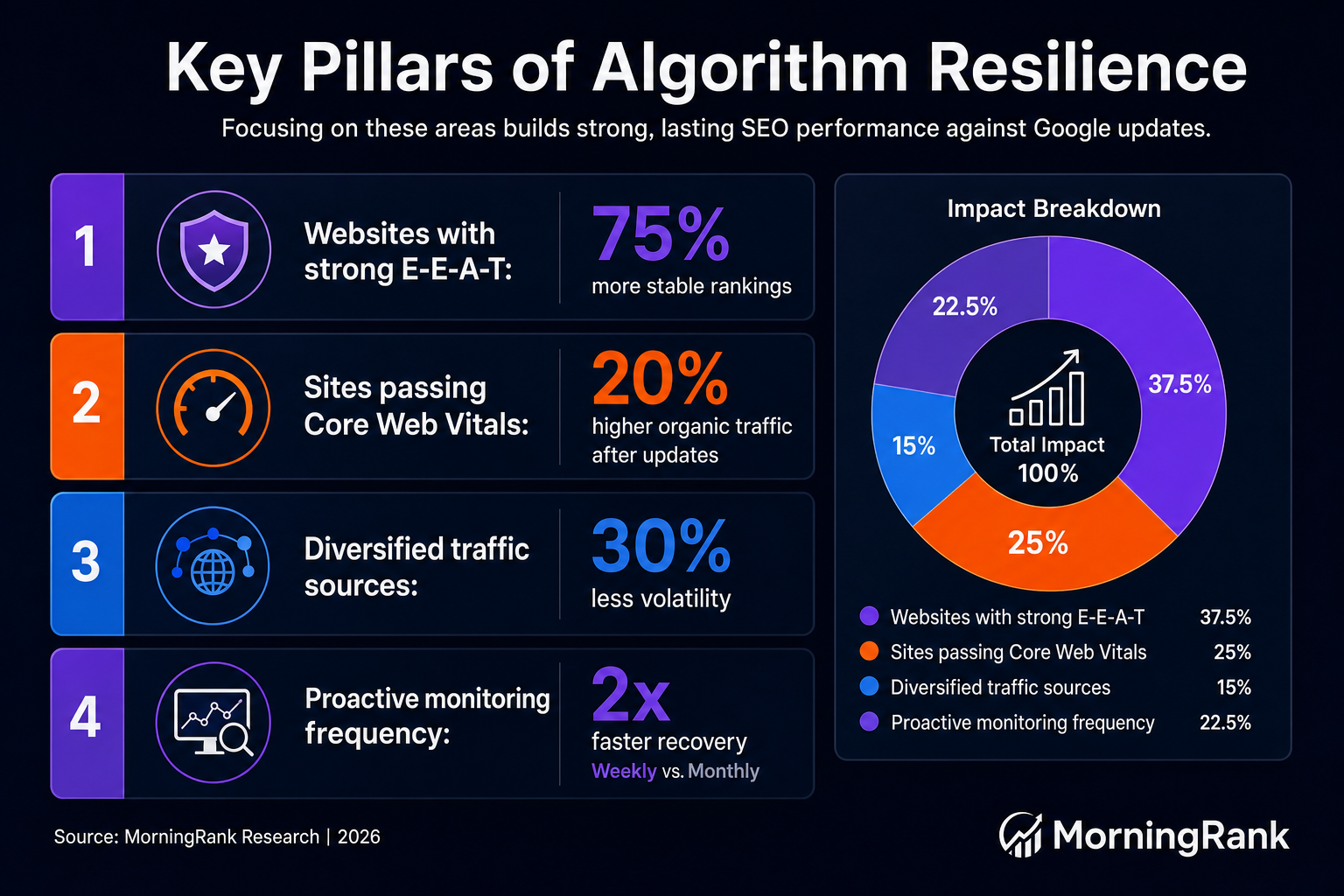
Why Is Google Algorithm Resilience Critical in 2026?
Google’s algorithms are not static, they are dynamic and constantly refined to provide users with the most relevant and highest-quality search results. Google conducts hundreds of thousands of experiments annually and makes thousands of changes to its search algorithms, with some updates being more noticeable than others. The sheer frequency of these adjustments means that relying on outdated SEO tactics is a recipe for instability.
Google algorithm resilience is the ability of a website's search performance to withstand negative impacts from Google algorithm updates and swiftly recover or even improve rankings. In my experience, websites that proactively build resilience are less susceptible to significant drops and are quicker to adapt. This proactive approach ensures consistent online visibility, stable organic traffic, and predictable lead generation for your business or your clients.
What are the primary drivers of Google's algorithm updates?
Google's algorithm updates are primarily driven by its mission to deliver the most relevant, high-quality, and helpful search results to users. This involves improving the understanding of user intent, combating spam, and enhancing the overall search experience. Key factors often targeted in updates include content quality, user experience signals (like Core Web Vitals), and the trustworthiness of sources, which Google broadly refers to as E-E-A-T.
How Does E-E-A-T Influence Algorithm Resilience?
E-E-A-T, which stands for Experience, Expertise, Authoritativeness, and Trustworthiness, is a foundational concept within Google's Quality Rater Guidelines and plays a crucial role in Google algorithm resilience. Google utilizes these principles to evaluate content and determine its suitability for various queries. Content that demonstrates strong E-E-A-T signals to Google that it is valuable and reliable, making it less likely to be negatively impacted by updates designed to demote low-quality or untrustworthy information. Focusing on E-E-A-T involves ensuring your content is written by knowledgeable individuals, thoroughly researched, factually accurate, and presented on a secure, reputable website. This strategy forms the bedrock of long-term SEO success.
How can agencies enhance E-E-A-T for their clients' websites?
Agencies can enhance E-E-A-T by prioritizing content creation from genuine experts, citing credible sources, and showcasing author credentials prominently. Build a robust backlink profile from authoritative sites to signal authority, and ensure all website content is regularly reviewed and updated for accuracy. Transparent contact information, strong privacy policies, and a secure website also contribute significantly to trustworthiness. Navigating Google’s E-E-A-T Updates: An Agency Playbook for 2026 provides further insights into integrating E-E-A-T principles.

What Role Does Technical SEO Play in Algorithm Stability?
Technical SEO provides the underlying structure that allows Google to effectively crawl, index, and understand a website, making it a cornerstone of Google algorithm resilience. A technically sound website ensures that Google can access and evaluate your content without hindrance. Factors such as site speed, mobile-friendliness, secure (HTTPS) connections, and a well-optimized crawl budget directly impact user experience and Google's ability to process your site. Websites with poor technical SEO are often slower, harder to navigate, and may experience indexing issues, all of which can be exacerbated by algorithm updates designed to prioritize better user experiences.
For example, Core Web Vitals (CWV), including Largest Contentful Paint (LCP), First Input Delay (FID), and Cumulative Layout Shift (CLS), are direct ranking factors. An update focused on user experience will disproportionately affect sites with failing CWV scores. Regular SEO audits using tools like MorningRank's ensure these technical aspects are continuously optimized.
Which technical SEO factors are most critical for resilience?
The most critical technical SEO factors for algorithm resilience include fast page load times, responsive design for mobile devices, secure HTTPS protocols, and a clear site structure for easy crawling. Optimizing Core Web Vitals, fixing broken links, managing crawl budget efficiently, and ensuring proper indexation are also paramount. These elements directly contribute to a positive user experience, a key focus for Google's algorithms, and underpin strong Google algorithm resilience.
How Can Continuous Monitoring and Adaptation Strengthen Your Strategy?
The SEO landscape is never static, which means your strategy for Google algorithm resilience cannot be either. Continuous monitoring and proactive adaptation are essential for spotting early signs of algorithmic shifts and responding effectively. This involves tracking key performance indicators (KPIs) like organic traffic, keyword rankings, conversion rates, and SERP feature visibility. Tools that offer AI-powered keyword rank tracking and real-time alerts are invaluable for agencies to detect anomalies quickly. When an update rolls out, immediate analysis of ranking changes, traffic patterns, and competitor performance is critical. This data-driven approach allows you to identify specific areas impacted and implement targeted adjustments, rather than reacting blindly. For deeper insights into analyzing update impacts, consider reading Mastering Google Algorithm Update Forensics: A 2026 Guide to Diagnosis.
Example of an Adaptive Strategy: If an update impacts content quality, your adaptation might involve enhancing E-E-A-T signals, updating outdated information, or expanding content depth. If technical issues are the cause, addressing Core Web Vitals or improving site speed would be the priority. This ongoing cycle of monitoring, analysis, and refinement is what truly builds Google algorithm resilience.
What metrics should agencies monitor post-update?
Post-update, agencies should closely monitor organic traffic changes, individual keyword ranking fluctuations (especially for money keywords), changes in search impression share, and the visibility of SERP features like AI Overviews and featured snippets. Additionally, keeping an eye on Core Web Vitals scores and bounce rates can reveal user experience impacts. Comparing these metrics against pre-update baselines helps identify the true extent and nature of any algorithmic shift, contributing to Google algorithm resilience.
Building Diversified Digital Footprints Beyond Google Organic
While optimizing for Google search is fundamental, true Google algorithm resilience also involves building a diversified digital footprint. Over-reliance on a single traffic source, even one as dominant as Google organic search, exposes you to significant risk during algorithm updates. Expanding your presence across various platforms and channels creates multiple avenues for reaching your audience and mitigates the impact of search ranking fluctuations. This includes investing in local SEO (Google Business Profile optimization), social media marketing, email marketing, paid advertising, and optimizing for new generative AI search experiences (AEO/GEO). Each additional channel acts as a safety net, ensuring that even if one area experiences a dip, your overall online visibility and lead generation remain stable. For local businesses, optimizing your Google Business Profile is paramount, as demonstrated by the fact that the local pack accounts for a significant portion of local search clicks (BrightLocal, 2023).
How can agencies diversify their clients' online presence effectively?
Agencies can diversify by implementing a multi-channel digital marketing strategy that includes robust local SEOactive social media engagement, targeted email campaigns, and strategic paid search or social ads. Optimizing for voice search and Generative Engine Optimization (GEO) for platforms like Google AI Overviews are also crucial in 2026. This holistic approach ensures that clients are visible across various touchpoints, strengthening their overall Google algorithm resilience and reducing dependency on traditional organic search alone.
Conclusion: Proactive Resilience for 2026 and Beyond
In 2026, building Google algorithm resilience is not just a reactive measure, it is a fundamental pillar of sustainable SEO success. By prioritizing E-E-A-T, maintaining impeccable technical SEO, continuously monitoring performance, and diversifying your digital footprint, you can effectively future-proof your strategies. This proactive approach ensures that your clients' websites not only survive Google's frequent updates but often thrive because of them. Remember, Google rewards websites that consistently deliver value and a superior user experience, and those are the very principles that underpin strong Google algorithm resilience. Embrace the challenge of continuous improvement, and you will find that each update presents an opportunity to solidify your market position. This strategic resilience transforms uncertainty into a competitive advantage.
Frequently Asked Questions
What are Google algorithm updates?
Google algorithm updates are changes Google makes to its ranking systems to improve the quality and relevance of search results. These updates can range from minor tweaks to major core updates, influencing how websites appear in search results. Building Google algorithm resilience helps websites navigate these changes effectively.
How often does Google release algorithm updates?
Google constantly makes thousands of small updates annually, many of which are imperceptible to SEOs. Larger, more impactful updates, known as core updates, are typically announced a few times a year. Maintaining strong Google algorithm resilience allows websites to absorb these frequent changes.
Can Google algorithm updates negatively impact my website's rankings?
Yes, Google algorithm updates can negatively impact website rankings if your site does not align with the updated ranking criteria, such as E-E-A-T or technical standards. However, they can also positively affect sites that already meet or exceed these new benchmarks. Proactive Google algorithm resilience minimizes negative impact.
What is the most important factor for Google algorithm resilience?
The most important factor for Google algorithm resilience is a holistic approach focused on delivering exceptional value to users through high-quality, expert-driven content (E-E-A-T) and an excellent technical user experience. Google consistently prioritizes helpful, reliable content. Prioritizing users will lead to Google algorithm resilience.
How long does it take to recover from a Google algorithm update?
Recovery time from a Google algorithm update varies widely depending on the severity of the impact and the nature of the issues. It can range from a few weeks to several months, or even longer for significant penalties. A proactive strategy for Google algorithm resilience can often prevent major drops.
How can MorningRank help agencies build Google algorithm resilience for clients?
MorningRank offers tools like AI-powered keyword rank tracking, automated SEO audits, AI SEO recommendations, and GEO/AEO tracking to help agencies monitor performance, identify issues, and proactively adapt strategies. Our platform empowers agencies to build robust Google algorithm resilience for their clients through continuous data insights and actionable advice.
Ready to build unparalleled Google algorithm resilience for your clients? Explore MorningRank's AI-powered SEO platform today and start your free trial at morningrank.com.
Want this kind of insight every week?
MorningRank delivers daily rank tracking, AI SEO recommendations, and white label client reporting.