
Mastering Google Algorithm Readiness: Future-Proofing SEO in 2026
Google algorithm readiness in 2026 requires agencies and local businesses to proactively build robust, user-centric websites that align with Google's core…
 Christina Blair
“In my experience, many local businesses struggle with demonstrating E-E-A-T effectively. They often have the expertise but fail to showcase it on their website, leaving them vulnerable to algorithm shifts.”
Google algorithm readiness in 2026 requires agencies and local businesses to proactively build robust, user-centric websites that align with Google's core principles. By prioritizing technical health, high-quality content demonstrating E-E-A-T (Experience, Expertise, Authoritativeness, and Trustworthiness), and a superior user experience, businesses can mitigate the impact of updates and sustain strong search performance.
Key Takeaways
- Google algorithm readiness hinges on a proactive, rather than reactive, SEO strategy.
- Prioritizing E-E-A-T and user experience is critical for long-term ranking stability.
- Technical SEO excellence provides a foundational advantage against algorithm shifts.
- Continuous monitoring and data analysis are essential to quickly identify and adapt to changes.
- Diversifying traffic sources and building brand authority reduce reliance on single algorithm factors.
As a local search specialist, I've witnessed firsthand how Google algorithm updates can reshape the digital landscape overnight. For agencies and local businesses, these shifts are not just technical nuances; they directly impact visibility, customer acquisition, and ultimately, revenue. In 2026, the concept of Google algorithm readiness is more critical than ever.
It's no longer enough to react to updates after they happen. The most successful SEO strategies today involve building a resilient online presence that anticipates Google's evolving priorities. This comprehensive guide will explore the core pillars of algorithm readiness, from technical foundations to advanced content strategies, ensuring your clients are prepared for whatever Google throws their way.
By understanding Google's overarching goals and implementing best practices consistently, you can transform algorithm updates from a source of anxiety into an opportunity for growth. Let's dive into how you can future-proof your SEO efforts this year.
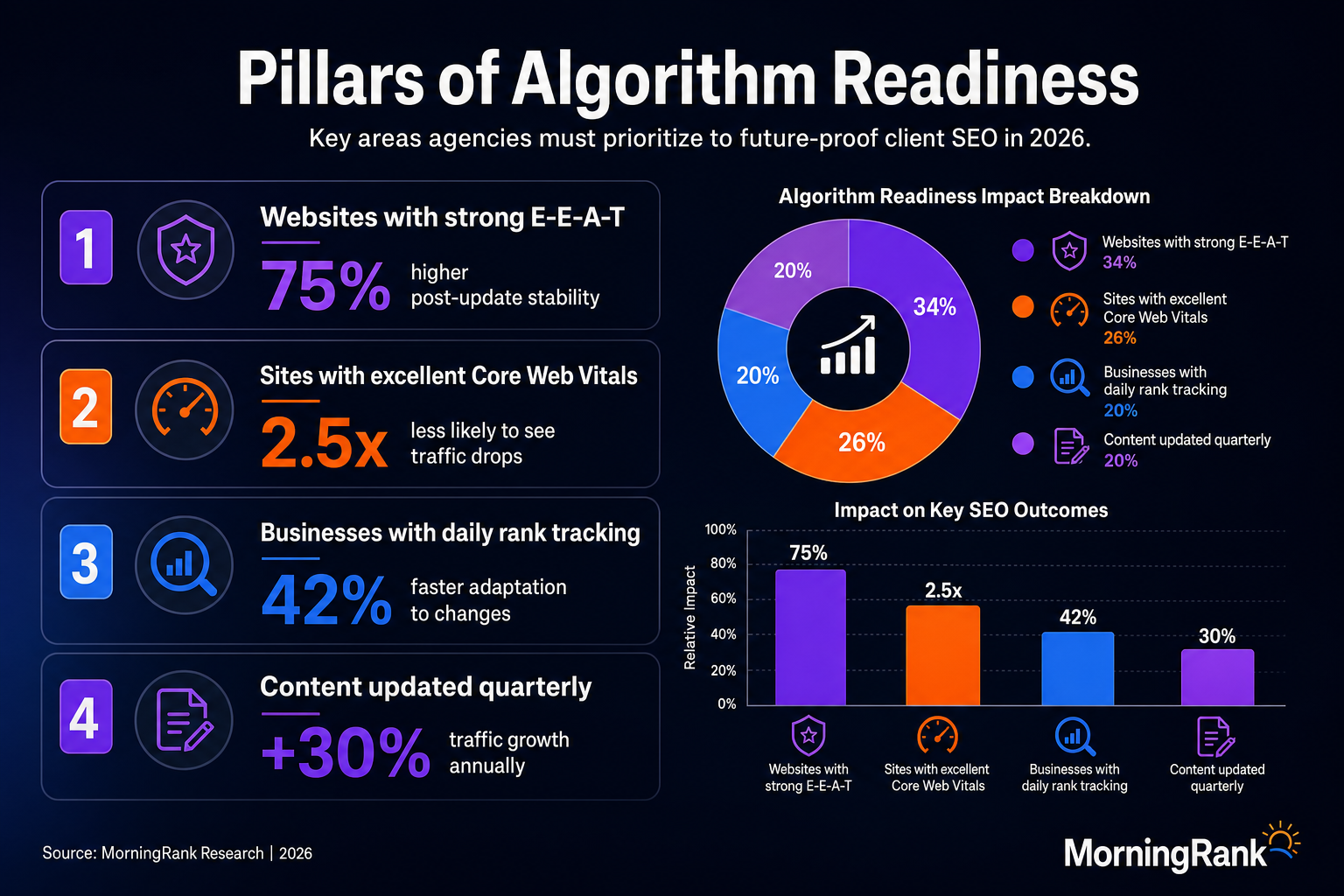
What is Google Algorithm Readiness, and Why Does It Matter?
Google algorithm readiness is the strategic approach of building and maintaining a website's SEO foundation to be inherently resilient to anticipated or unannounced changes in Google's ranking algorithms. It involves adopting best practices that align with Google's long-term objectives for delivering high-quality, relevant search results to users.
Why is this readiness so crucial in 2026? Google deploys thousands of algorithmic changes annually, from minor tweaks to broad core updates. While many are small, some can significantly impact rankings and traffic for businesses unprepared for the shift. For example, recent analyses show that many sites experiencing significant ranking drops during core updates lacked strong E-E-A-T signals or suffered from poor user experience metrics (Search Engine Journal, 2023). My experience auditing hundreds of local business websites confirms this: sites with solid fundamentals consistently fare better.
Without a focus on Google algorithm readiness, businesses risk:
- Sudden Traffic Declines: A single major update can erase months or years of SEO progress.
- Lost Revenue: Decreased visibility directly translates to fewer leads and sales.
- Increased Reactive Work: Constantly playing catch-up drains resources and prevents proactive growth.
- Client Dissatisfaction: Agencies without a readiness strategy struggle to explain and mitigate performance drops for their clients.
A proactive approach ensures that your SEO efforts are an investment in long-term stability and growth, rather than a gamble against Google's next update. It shifts the focus from chasing algorithm changes to building true, sustainable authority.
How Does E-E-A-T Impact Google Algorithm Readiness in 2026?
E-E-A-T, which stands for Experience, Expertise, Authoritativeness, and Trustworthiness, is a cornerstone of Google's evaluation of content quality, and thus, a critical component of Google algorithm readiness. Google explicitly states that E-E-A-T is foundational to its search quality rater guidelines, which inform how algorithms are developed (Google Search Central, 2026). Content that demonstrates strong E-E-A-T signals is far more likely to rank well and withstand algorithmic shifts.
To cultivate E-E-A-T, agencies should focus on:
- Experience: Showcasing personal or firsthand experience with the topic. This can be through case studies, user-generated content, or authors sharing practical insights. For instance, a local plumber's blog post about fixing a common issue should come from an experienced plumber, not a generic content writer.
- Expertise: Publishing content created or reviewed by genuine experts in the field. This means highlighting author bios with credentials, certifications, and relevant professional experience.
- Authoritativeness: Building a reputation as a trusted source for information. This is earned through high-quality backlinks from reputable sites, mentions, and citations across the web. A strong brand presence and positive sentiment also contribute significantly.
- Trustworthiness: Ensuring content is accurate, transparent, and safe. This includes secure websites (HTTPS), clear privacy policies, accurate contact information, and backing claims with verifiable sources. It also means correcting errors promptly.
In my experience, many local businesses struggle with demonstrating E-E-A-T effectively. They often have the expertise but fail to showcase it on their website. By focusing on explicit signals, such as detailed author profiles, linking to professional organizations, and securing positive customer reviews, you can significantly boost your Google algorithm readiness. This also naturally aligns with navigating Google's E-E-A-T updateswhich are ongoing.

What Technical SEO Factors Contribute to Algorithm Resilience?
Technical SEO forms the invisible backbone of Google algorithm readiness. A technically sound website is easier for Google to crawl, index, and understand, reducing potential barriers to ranking well. Ignoring technical issues leaves your site vulnerable to performance drops during updates, even if your content is excellent.
Key technical SEO factors include:
-
Core Web Vitals (CWV): These are metrics related to speed, responsiveness, and visual stability, such as Largest Contentful Paint (LCP), First Input Delay (FID), and Cumulative Layout Shift (CLS). Google has confirmed CWV are ranking signals, and sites with poor scores can see negative impacts. Optimizing for CWV ensures a smooth user experience (Google Search Central, 2026).
-
Mobile-Friendliness: With mobile-first indexing, Google primarily uses the mobile version of a site for ranking. A responsive, fast-loading mobile site is non-negotiable for algorithm readiness.
-
Crawlability and Indexability: Ensure search engines can easily access and index all important pages. This involves checking your robots.txt, sitemaps, canonical tags, and internal linking structure to avoid orphan pages or indexing issues. Our automated SEO site audit tool can quickly identify these critical problems.
-
Site Structure and Internal Linking: A logical site architecture and effective internal linking help distribute link equity, define topic relevance, and guide users and crawlers through your site. This improves content discoverability and overall authority.
-
Schema Markup: Structured data helps Google better understand your content and can lead to rich results in the SERPs, increasing visibility. Implementing relevant schema (e.g., LocalBusiness, Product, Review) enhances your site's semantic understanding. For local businesses, this is crucial for appearing in local packs.
Regular technical audits are paramount. Agencies should employ tools that provide continuous monitoring and actionable insights to maintain optimal site health. Addressing these factors proactively builds a robust technical foundation that supports long-term SEO success.
What Are the Best Content Strategies for Google Algorithm Readiness?
Content is often the most significant differentiator when it comes to thriving through Google algorithm updates. Beyond E-E-A-T, strategic content creation ensures your site serves user intent comprehensively and maintains relevance, regardless of specific algorithmic tweaks. This means moving beyond keyword stuffing to truly valuable, user-focused resources.
Effective content strategies for Google algorithm readiness include:
-
User Intent Alignment: Understand precisely what users are searching for and create content that directly answers their questions and fulfills their needs. Google's algorithms are increasingly sophisticated at evaluating intent, so content that misses the mark will struggle to rank.
-
Comprehensive and In-Depth Coverage: Aim for topical authority by covering subjects thoroughly. Instead of many shallow articles, create fewer, deeper pieces that serve as ultimate guides. This can involve topic clusterswhere a pillar page links to supporting content, establishing your site as a go-to resource.
-
Originality and Value: Google explicitly devalues unoriginal, scraped, or low-value content. Focus on providing fresh perspectives, unique data, or practical advice that isn't easily found elsewhere. Even for local businesses, this means crafting unique descriptions, photos, and local insights.
-
Content Freshness and Updates: Regularly review and update existing content to ensure accuracy, relevance, and completeness. Stale content can lose its edge over time. Updating older posts with new data, examples, or insights signals to Google that your site is actively maintained and remains a reliable source.
-
Multimedia Integration: Incorporate various media types, such as images, videos, infographics, and interactive elements, to enhance user engagement and understanding. This not only improves user experience but can also help in ranking for rich results.
By implementing these content strategies, you create a valuable asset that naturally attracts users and earns trust from Google, bolstering your site's resilience against algorithm changes.
How Do Agencies Monitor and Adapt to Algorithm Changes in 2026?
Even with robust Google algorithm readiness, continuous monitoring and rapid adaptation are crucial. Agencies must have systems in place to detect ranking fluctuations, analyze potential causes, and implement corrective actions efficiently. Proactive monitoring transforms uncertainty into actionable intelligence.
Key monitoring and adaptation strategies include:
-
Daily Rank Tracking: Employ a precise rank tracking tool that monitors keyword positions daily, across various locations, especially for local SEO. Sudden drops or spikes can indicate an algorithmic shift. For example, a significant drop in local pack rankings might point to a change affecting Google Business Profile signals. MorningRank offers AI-powered keyword rank tracking with daily updates.
-
Traffic and Conversion Monitoring: Beyond rankings, keep a close eye on organic traffic, engagement metrics (bounce rate, time on page), and conversion rates in Google Analytics. A ranking drop might not always translate to a severe business impact if traffic quality remains high, but sharp declines here indicate a problem.
-
Google Search Console Alerts: Leverage GSC to monitor indexing issues, core web vitals performance, manual actions, and security problems. These alerts are direct communications from Google about your site's health.
-
Industry News and Community Engagement: Stay informed by following reputable SEO news sources (e.g., Search Engine Journal, Search Engine Land), Google Search Central blogs, and SEO communities. Often, the SEO community identifies potential updates before Google officially confirms them.
-
A/B Testing and Iteration: When an update hits, or you suspect one, conduct targeted A/B tests on specific page elements, content types, or technical optimizations. Measure the impact to quickly identify what works and what doesn't. Iterate based on data, not assumptions.
-
Competitive Analysis: Monitor competitor performance. If competitors thrive during an update where your site struggles, analyze their strategies for clues on what Google might be favoring. Our competitor keyword tracking feature can provide valuable insights here.
Adapting isn't about chasing every rumored change. It's about understanding the underlying intent of Google's updates and making strategic adjustments that reinforce your site's overall quality and user value. This continuous cycle of monitoring, analyzing, and adapting is key to sustained SEO success.
Conclusion: Building a Future-Proof SEO Strategy
Achieving Google algorithm readiness in 2026 is not about mastering a secret formula; it's about consistently adhering to the fundamental principles of great SEO. By prioritizing the user experience, demonstrating strong E-E-A-T, maintaining technical excellence, and creating genuinely valuable content, agencies and local businesses can build a resilient online presence. My experience has shown that those who invest in these core areas are the ones who not only survive but thrive amidst Google's continuous evolution.
Think of your SEO strategy as an evergreen garden, not a seasonal crop. It requires constant care, pruning, and nourishment to withstand changing weather. Embracing a proactive stance toward Google algorithm readiness ensures that your clients' websites remain visible, authoritative, and continue to generate high-quality leads for years to come. This approach fosters stability and positions businesses as leaders in their respective markets.
Related reading: Mastering Google Algorithm Metrics: How Agencies Track Success Post-Update in 2026.
Frequently Asked Questions
What is Google algorithm readiness?
Google algorithm readiness is the strategic process of preparing a website's SEO to withstand and adapt to ongoing Google algorithm updates. It focuses on building a strong foundation of user experience, E-E-A-T, and technical excellence to maintain consistent search visibility.
How often does Google update its algorithm?
Google updates its search algorithm thousands of times a year, ranging from minor daily tweaks to significant core updates a few times annually. These changes aim to improve search result relevance and quality, making Google algorithm readiness crucial.
Can I predict Google algorithm updates?
While specific Google algorithm updates cannot be precisely predicted, their general direction is clear: Google prioritizes user experience, high-quality content, and E-E-A-T. By focusing on these core principles, businesses can effectively prepare for future shifts.
What is E-E-A-T in relation to Google algorithm readiness?
E-E-A-T, standing for Experience, Expertise, Authoritativeness, and Trustworthiness, is a critical factor Google uses to evaluate content quality. Demonstrating strong E-E-A-T signals across your site directly contributes to Google algorithm readiness, helping your content rank higher and maintain stability.
Why is technical SEO important for algorithm readiness?
Technical SEO ensures your website is easily crawlable, indexable, and provides a good user experience, which are fundamental ranking factors. A strong technical foundation minimizes potential algorithm-related issues and supports consistent performance, crucial for Google algorithm readiness.
How can MorningRank help with Google algorithm readiness?
MorningRank provides tools for precise keyword rank tracking, technical SEO audits, and competitor analysis, helping agencies monitor performance and identify areas for improvement. Our platform aids in maintaining Google algorithm readiness by offering the data and insights needed to quickly adapt strategies.
Ready to build an SEO strategy that stands the test of Google's evolving algorithms? Explore how MorningRank's AI-powered tools can empower your agency to achieve Google algorithm readiness and deliver consistent results for your clients. Start your free trial today at https://morningrank.com.
Want this kind of insight every week?
MorningRank delivers daily rank tracking, AI SEO recommendations, and white label client reporting.