
Mastering Google Algorithm Updates: A Proactive Content Strategy for 2026
Navigating Google algorithm updates in 2026 requires a proactive content strategy focused on core principles.
 Christina Blair
“In my experience, a consistent, proactive content strategy built on E-E-A-T, user intent, and topical authority is the most effective shield against algorithm volatility and the most reliable path to sustained SEO success.”
Navigating Google algorithm updates in 2026 requires a proactive content strategy focused on core principles. Agencies and local businesses must adapt by prioritizing high-quality, user-centric content that demonstrates E-E-A-T and fulfills search intent. This approach ensures long-term search visibility and resilience against ranking fluctuations. Google algorithm updates are constant adjustments to how search results are ranked.
Key Takeaways
- Google algorithm updates prioritize high-quality, relevant content that genuinely helps users.
- A proactive content strategy built on E-E-A-T, user intent, and topical authority is crucial for sustained rankings.
- Diversify content types and distribution channels to maintain visibility across traditional search and AI answer engines.
- Continuous monitoring of performance metrics and iterative content optimization are essential for adapting to algorithmic shifts.
- Technical SEO and user experience remain foundational elements supporting content performance post-update.
The digital landscape is in constant flux, with Google's algorithm updates serving as the primary catalyst for change. For agencies and local businesses, these updates can feel like unpredictable seismic events, dramatically shifting search rankings and impacting organic traffic. Yet, in my experience, a consistent, proactive content strategy is the most effective shield against volatility and the most reliable path to sustained SEO success. This post will delve into understanding the evolving nature of Google's algorithms and provide a comprehensive content-centric framework for adaptation in 2026.
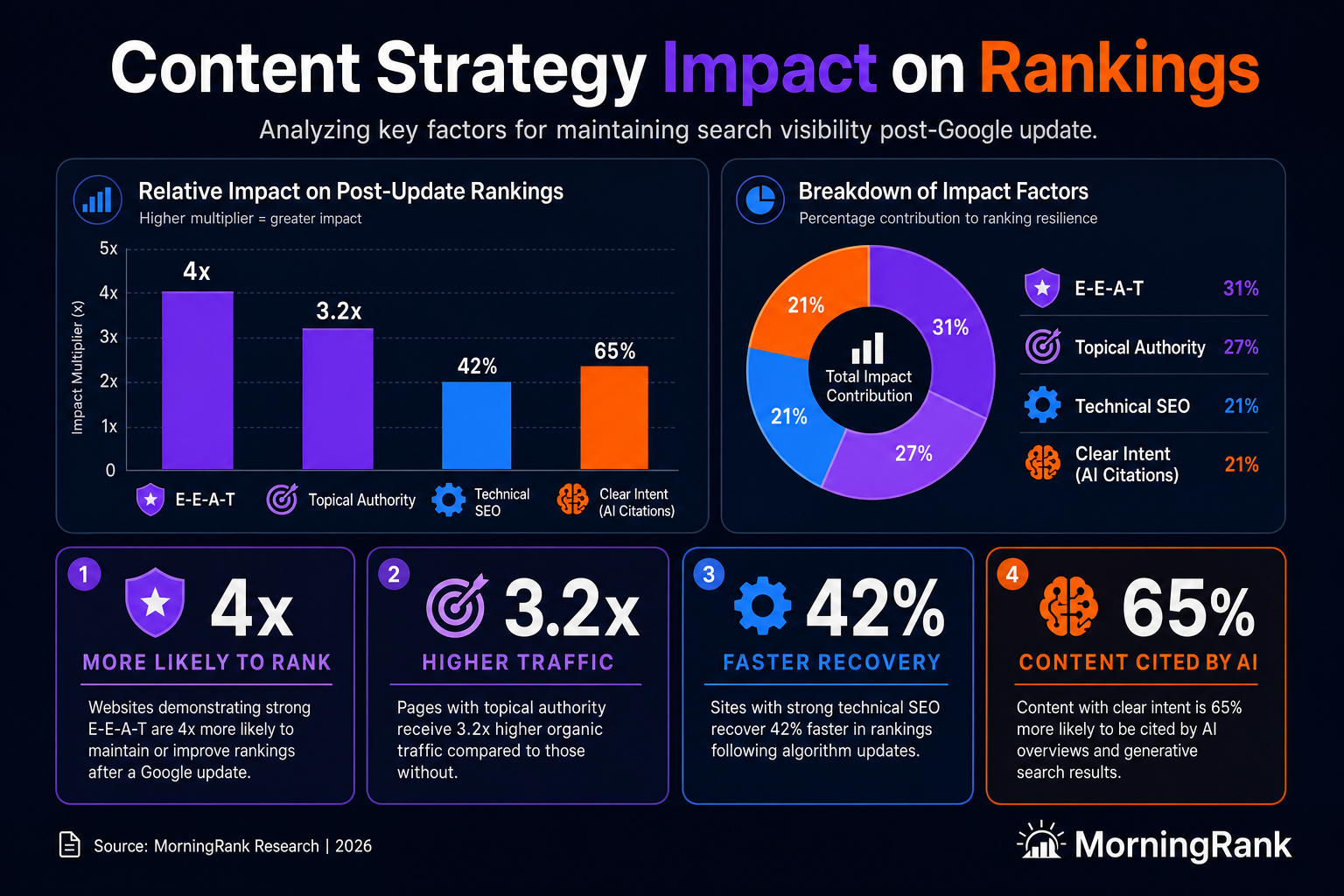
What is the Impact of Google Algorithm Updates on Content Strategy?
Google algorithm updates are changes to the complex system Google uses to rank websites in search results. These updates often focus on improving search quality by rewarding content that is helpful, authoritative, and user-friendly, while demoting content that is low quality, spammy, or irrelevant. In 2026, the impact on content strategy is profound, shifting the focus even more heavily onto true value creation rather than keyword stuffing or manipulative tactics. Google's core mission remains to provide the most relevant and highest-quality information to its users, and every algorithm update reinforces this goal.
For content creators, this means every piece of content must be meticulously crafted to serve a clear purpose and satisfy specific user intent. Websites with strong E-E-A-T (Experience, Expertise, Authoritativeness, and Trustworthiness) signals consistently fare better during and after updates. Content that lacks depth, originality, or verifiable facts is increasingly at risk. As a local search specialist, I've audited countless sites where ranking drops could be directly attributed to a failure to meet these quality standards, particularly after significant core updates.
Beyond traditional search, the rise of AI answer engines and generative AI has amplified the need for high-quality, structured content. Content that is easily digestible and factually accurate is more likely to be cited by platforms like Google AI Overviews, directly impacting AI search visibility. Therefore, every algorithm update now also has implications for your GEO content strategyrequiring a dual approach to optimization.
How Does E-E-A-T Influence Content Adaptation?
E-E-A-T is not merely a buzzword, it is a foundational pillar of Google's evaluation of content quality. E-E-A-T stands for Experience, Expertise, Authoritativeness, and Trustworthiness. These factors guide Google's human Quality Raters and are increasingly integrated into the algorithm itself. To adapt your content strategy, you must explicitly demonstrate E-E-A-T across all your digital assets. For instance, content authored by a recognized expert in the field, with clear credentials and a history of reliable information, will naturally outperform generic content.
Experience: Does your content reflect first-hand experience with the topic? This is particularly relevant for reviews, tutorials, or problem-solving content. Showing actual use or engagement with a product or service adds a layer of authenticity that algorithms can detect through user signals and explicit content cues. Case studies and personal anecdotes (where appropriate) can fulfill this requirement effectively.
Expertise: Is the content created by someone with demonstrable knowledge of the subject matter? This could be a certified professional, an industry veteran, or someone with extensive academic background. Ensure author bios are robust, showcasing relevant qualifications and experience. This also extends to the depth and accuracy of the information provided within the content itself.
Authoritativeness: Is the website or author generally recognized as a go-to source for the topic? This is often built through consistent high-quality output, positive mentions from other authoritative sites, and a strong backlink profile. Think of it as your reputation in the digital sphere. High-quality backlinks from relevant and respected domains signal authority to Google.
Trustworthiness: Can users trust the information presented? This involves transparent sourcing, accurate facts, secure website infrastructure (HTTPS), clear privacy policies, and a strong online reputation. User reviews, positive sentiment on social media, and a lack of egregious technical errors all contribute to trustworthiness. A strong E-E-A-T strategy is crucial for longevity.

What Role Does User Intent Play in Algorithm-Resilient Content?
Understanding and addressing user intent is paramount for crafting content that withstands Google algorithm updates. User intent refers to the primary goal a user has when typing a query into a search engine. Google's algorithms are increasingly sophisticated at discerning this intent and matching users with the most relevant content, even if keywords aren't an exact match. My advice for agencies is always to start with the user: "What problem are they trying to solve?" or "What information are they truly seeking?".
Content that fails to satisfy user intent, even if it's well-written and keyword-rich, will struggle to rank. For example, if a user searches for "best local coffee shops, " they likely want a list of establishments with reviews, locations, and maybe operating hours, not a historical overview of coffee production. Your content must directly address these needs. This often means going beyond simple informational articles to include actionable advice, product comparisons, local listings, or interactive elements.
To optimize for user intent, conduct thorough keyword research that goes beyond search volume. Analyze the SERPs (Search Engine Results Pages) for your target keywords. Look at the types of content already ranking: Are they guides, product pages, local listings, videos, or news articles? This provides invaluable clues about the intent Google perceives for that query. Your content strategy should aim to create the best possible resource for that specific intent. For local businesses, ensuring your local SEO tracking reflects relevant local search intent is critical.
How Can Topical Authority Strengthen Your Content Strategy?
Topical authority is a key differentiator in the competitive search landscape of 2026, especially in the wake of continuous Google algorithm updates. Topical authority refers to establishing your website as a comprehensive and trusted resource on a particular subject area. Instead of focusing on individual keywords in isolation, this strategy builds a broad, interconnected web of content around a central theme, effectively covering all aspects of a topic.
When Google's algorithms see that your site consistently publishes in-depth, high-quality content across a specific topic cluster, it signals that you are an authority on that subject. This holistic approach helps your individual pieces of content rank higher because they are supported by the collective strength of your entire topic library. This is far more resilient to algorithm shifts than a fragmented, keyword-centric approach.
To build topical authority, employ a topic cluster strategy. Identify a broad pillar topic, then create numerous supporting articles that delve into specific sub-topics and related questions. These supporting articles should link back to the pillar content, and the pillar content should link out to the supporting articles. This internal linking structure reinforces the topical relevance and helps Google understand the relationships between your content pieces. This comprehensive coverage positions your site as a definitive resource, making it less susceptible to fluctuations when algorithms adjust their understanding of content quality and relevance.
What Technical SEO Considerations Impact Content Post-Update?
While content quality is paramount, even the best content can struggle without a solid technical SEO foundation. Google algorithm updates often include refinements to how technical factors are evaluated, emphasizing user experience signals. In 2026, a fast, secure, and mobile-friendly website is non-negotiable. Technical issues can silently undermine your content efforts, making it harder for search engines to crawl, index, and understand your pages.
Key technical considerations include:
- Core Web Vitals: These metrics (Largest Contentful Paint, First Input Delay, Cumulative Layout Shift) measure page loading speed, interactivity, and visual stability. Google uses them as a direct ranking factor. Optimizing images, leveraging browser caching, and minimizing JavaScript are critical steps to improve Core Web Vitals.
- Mobile-First Indexing: Google primarily uses the mobile version of your content for indexing and ranking. Ensure your website is fully responsive and offers an excellent mobile user experience.
- Site Structure and Navigation: A logical, easy-to-navigate site structure helps both users and search engine crawlers find your content. Clear internal linking and a well-organized hierarchy are essential.
- Schema Markup: Implementing structured data (Schema Markup) helps search engines understand the context of your content, leading to richer search results (rich snippets) and improved visibility, especially for AI answer engines.
- Security (HTTPS): A secure website is a basic expectation for users and a ranking signal for Google. Ensure all your sites use HTTPS.
Regular technical audits are essential to identify and fix issues promptly. Tools like MorningRank's SEO audit tool can quickly pinpoint areas needing improvement, ensuring your content has the best possible technical stage to perform.
Conclusion
Google algorithm updates are an ongoing reality of SEO, but they don't have to be a source of constant anxiety. By embracing a proactive content strategy centered on E-E-A-T, deeply understanding user intent, building topical authority, and maintaining a robust technical foundation, agencies and local businesses can not only adapt but thrive. The goal is to create content that genuinely serves your audience, demonstrating clear value and establishing your credibility in your niche. This user-first, quality-driven approach is what Google consistently rewardsensuring your visibility across both traditional search and the burgeoning landscape of AI answer engines. Staying agile and continuously optimizing your content based on performance data is the ultimate strategy for sustained success in 2026 and beyond.
Frequently Asked Questions
What are Google algorithm updates?
Google algorithm updates are changes to the complex system Google uses to rank websites in its search results. These updates aim to improve search quality by delivering more relevant, helpful, and trustworthy content to users.
How often does Google release algorithm updates?
Google makes thousands of changes to its search algorithms every year, but most are minor. Major core updates, which can have a significant impact on rankings, are typically announced a few times annually.
How do I know if my website was affected by an algorithm update?
Significant drops or gains in organic traffic and keyword rankings that coincide with a confirmed Google algorithm update are strong indicators. Monitoring tools and Google Search Console data can help identify these fluctuations quickly.
What is the most important factor for ranking after an algorithm update?
After a Google algorithm update, the most important factor is creating high-quality, user-centric content that demonstrates strong E-E-A-T (Experience, Expertise, Authoritativeness, and Trustworthiness) and clearly satisfies user intent.
Can I recover from a ranking drop caused by a Google algorithm update?
Yes, recovery is often possible by identifying the aspects of your content or technical SEO that no longer align with Google's quality guidelines, then implementing targeted improvements based on those insights.
How can MorningRank help me adapt to Google algorithm updates?
MorningRank provides AI-powered tools for keyword rank tracking, technical SEO audits, and competitor analysis, helping agencies and local businesses monitor performance, identify issues, and implement proactive content strategies to adapt to Google algorithm updates. Our platform offers insights to maintain and improve search visibility.
Ready to build an algorithm-resilient content strategy for your clients? Try MorningRank free today and experience the difference AI-powered SEO insights can make at https://morningrank.com.
Want this kind of insight every week?
MorningRank delivers daily rank tracking, AI SEO recommendations, and white label client reporting.