
Mastering Google Algorithm Update Resilience in 2026
Achieving Google algorithm update resilience in 2026 means consistently maintaining or improving search rankings despite Google's frequent changes.
 Christina Blair
“In my experience, sites built on a foundation of strong E-E-A-T and technical excellence demonstrate significantly greater Google algorithm update resilience, often recovering quicker or even seeing gains during major shifts.”
Achieving Google algorithm update resilience in 2026 means consistently maintaining or improving search rankings despite Google's frequent changes. It involves proactively aligning SEO strategies with Google's stated goals of user-centricity, E-E-A-T, and technical excellence, rather than reacting to each individual update.
Key Takeaways
- Google algorithm updates are continuous, so proactive resilience is more effective than reactive fixes.
- Focus on E-E-A-T (Experience, Expertise, Authoritativeness, Trustworthiness) as a foundational principle for enduring SEO.
- Technical SEO health, user experience, and mobile-friendliness are critical for resisting negative algorithm impacts.
- Regularly monitor performance metrics to detect early signs of algorithm-related shifts.
- Diversify traffic sources and implement a comprehensive content strategy to mitigate update risks.
Google algorithm updates are a constant, often unpredictable force in the SEO landscape, transforming the digital environment for agencies and local businesses alike. In 2026, merely reacting to these changes is no longer sufficient. Instead, a proactive approach centered on Google algorithm update resilience is paramount. This involves understanding the underlying principles Google prioritizes, building robust websites, and implementing adaptive SEO strategies that can weather any storm. This post will guide you through the essential components of future-proofing your SEO efforts, ensuring your clients maintain strong visibility regardless of the latest update.
What Does Google Algorithm Update Resilience Mean for Agencies?
Google algorithm update resilience is the capacity of a website's search performance to withstand and quickly recover from fluctuations caused by Google's continuous algorithm modifications. It signifies an SEO strategy that is inherently stable and less susceptible to the volatility often associated with major and unconfirmed updates. For agencies, building this resilience for clients means safeguarding their online presence and ensuring consistent organic traffic and lead generation.
Google aims to deliver the most relevant and highest-quality results to users. Therefore, sites that consistently meet these criteria are naturally more resilient. Agencies must shift from a reactive "fix-it-after-the-update" mentality to a proactive "build-it-to-last" strategy. This involves a deep understanding of Google's overarching goals and implementing them into every aspect of a client's SEO campaign. My experience auditing numerous sites post-update shows that those with strong foundational SEO, user experience, and content quality rarely see catastrophic drops. For instance, data from a study by BrightLocal in 2025 indicated that 91% of local consumers used online search to find local businessesunderscoring the critical need for stable, resilient local search rankings.
Why is Proactive Resilience Critical in 2026?
In 2026, Google's algorithms are more sophisticated and dynamic than ever, incorporating advanced machine learning and AI to evaluate content and user experience. This means updates are not just periodic events but a continuous evolution. Proactive resilience ensures that your SEO strategies are aligned with Google's long-term vision, making your clients less vulnerable to sudden ranking shifts. It protects against lost revenue, reputational damage, and the significant time and resources required for recovery efforts. Moreover, as AI Overviews become more prevalent, maintaining foundational excellence ensures content remains discoverable across diverse search interfaces.
How Do E-E-A-T and User Experience Contribute to Update Resilience?
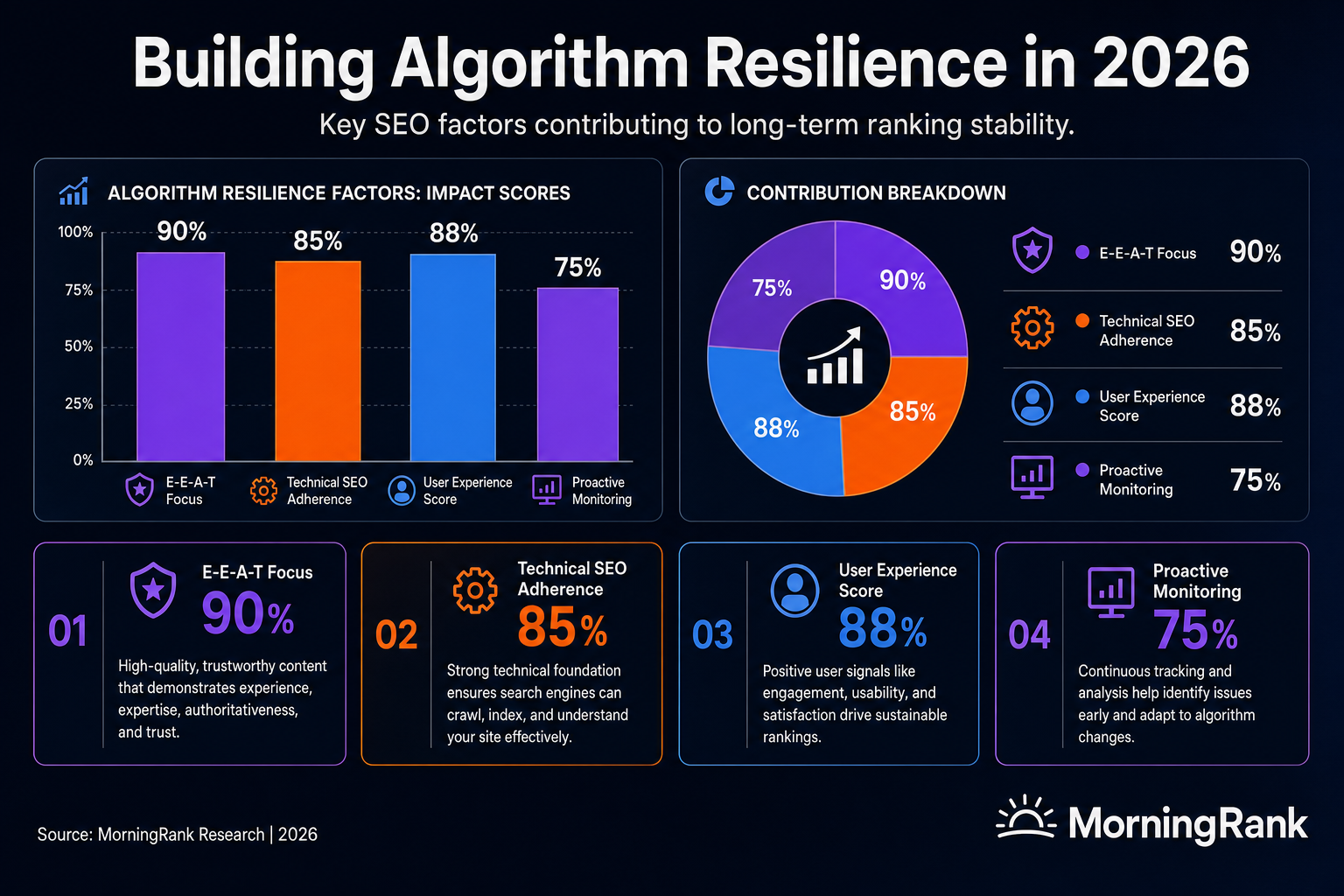
E-E-A-T (Experience, Expertise, Authoritativeness, and Trustworthiness) and user experience are foundational pillars of Google algorithm update resilience. Google explicitly states that its ranking systems are designed to reward content that demonstrates these qualities. By prioritizing E-E-A-T, you are essentially aligning your content and website with Google's core objectives, which builds inherent stability.
For example, a site that features content written by verified experts, cites authoritative sources, and provides a clear, transparent user journey will naturally perform better and be less impacted by updates focused on quality and credibility. Google's helpful content system specifically targets content that is primarily created for search engine rankings rather than for helping people. Therefore, creating truly helpful, expert-driven content is a direct path to resilience. Similarly, a superior user experience, encompassing fast loading times, intuitive navigation, and mobile-friendliness, signals to Google that your site provides value, which is consistently rewarded across various algorithm updates. This holistic approach strengthens a site's standing and future-proofs it against unexpected shifts.
What are the Key Elements of a Resilient User Experience?
A resilient user experience (UX) is characterized by several key elements that Google consistently values. First, page speed and Core Web Vitals are crucial. Users expect fast-loading pages, and Google rewards sites that deliver this. Second, mobile-friendliness is non-negotiable; with most searches now happening on mobile devices, a responsive design that provides a seamless experience across all screen sizes is vital. Third, intuitive navigation and clear calls to action enhance user satisfaction, encouraging longer visits and lower bounce rates. Finally, secure connections (HTTPS) and minimal intrusive ads contribute to a trustworthy environment, further boosting Google algorithm update resilience. Focusing on these elements creates a website that not only pleases users but also satisfies Google's quality metrics. Agencies can leverage tools like MorningRank's Automated SEO Site Audits to consistently monitor and improve these critical UX factors for their clients.

What Technical SEO Practices Build Strong Algorithm Resilience?
Robust technical SEO practices are indispensable for building Google algorithm update resilience. These are the underlying structural elements of a website that enable search engines to efficiently crawl, index, and understand your content. Neglecting technical SEO can leave a site vulnerable, even if its content is excellent.
Regular site audits are a cornerstone, identifying and resolving issues like broken links, crawl errors, and duplicate content. Ensuring your site has a clean, well-structured sitemap and robots.txt file guides search engine bots effectively. Proper use of schema markup helps search engines understand the context of your content, which is increasingly important for rich snippets and AI Overviews. Optimizing for site speed, as mentioned earlier, is a blend of technical and UX considerations. Moreover, managing crawl budget efficiently, especially for large sites, prevents Google from missing critical pages. Mastering Google Algorithm Update Proofing in 2026 provides further insights into technical safeguards. A strong technical foundation ensures that Google can always access and properly evaluate your high-quality content, regardless of algorithmic changes.
How Does Core Web Vitals Impact Algorithm Readiness?
Core Web Vitals, a set of metrics related to speed, responsiveness, and visual stability, directly impact Google algorithm readiness. These metrics (Largest Contentful Paint, First Input Delay, and Cumulative Layout Shift) are part of Google's page experience signals and significantly influence how content is perceived by both users and search engines. Sites with strong Core Web Vitals demonstrate a commitment to user experience, a factor Google consistently rewards. This means that a technically optimized site, scoring well on these metrics, is inherently better positioned to withstand algorithm updates that prioritize page experience. I've seen firsthand how improving Core Web Vitals can mitigate negative ranking impacts during an update, even leading to gains in some cases. Learn more in our Mastering Core Web Vitals in 2026 guide.
How Can Agencies Monitor and Adapt to Unconfirmed Updates?
Agencies can effectively monitor and adapt to unconfirmed Google algorithm updates by employing a combination of continuous tracking, data analysis, and agile strategy adjustments. Unconfirmed updates are minor, often daily, adjustments to Google's algorithms that are not officially announced but can still cause significant ranking fluctuations. Staying ahead requires vigilance and the right tools.
Implement daily rank tracking for your clients' most critical keywords, segmented by location and device, using a tool like MorningRank's AI-powered keyword rank tracking. Monitor traffic patterns in Google Analytics 4 and impression/click data in Google Search Console for any sudden anomalies. Look for patterns across multiple clients or specific niches to identify broader trends. When a shift occurs, analyze what commonalities exist among affected pages (e.g., content type, technical issues, link profiles). This allows for a data-driven response rather than guessing. Adapt by prioritizing content improvements based on E-E-A-T, addressing technical debt, and refining your backlink strategy. Remember, Google Search Liaison Danny Sullivan stated in 2025 that Google makes "thousands of changes" to its search systems every year, emphasizing the continuous nature of updates, as reported by Search Engine Journal. This highlights the importance of robust monitoring.
What Tools Are Essential for Post-Update Analysis?
For effective post-update analysis, several tools are essential. MorningRank offers comprehensive competitor keyword trackingproviding insights into how rivals are performing. Google Search Console is invaluable for identifying crawl errors, indexing issues, and performance drops. Google Analytics 4 helps track user behavior changes and traffic sources. Specialized SEO platforms like MorningRank provide advanced keyword rank tracking, visibility across AI Overviews, and automated SEO audits. These tools collectively enable agencies to pinpoint the impact of updates, diagnose root causes, and formulate targeted recovery strategies, ensuring sustained Google algorithm update resilience.
Conclusion
Achieving Google algorithm update resilience in 2026 is no longer a luxury but a necessity for agencies and local businesses aiming for sustained search visibility. By prioritizing E-E-A-T, fostering an exceptional user experience, maintaining robust technical SEO, and employing continuous monitoring, you can build a stable and adaptable online presence. Embrace a proactive mindset, focusing on foundational excellence rather than reactive fixes. This strategic shift not only protects against potential ranking drops but also positions your clients for long-term success in an ever-evolving search landscape.
Related reading: Mastering Google Algorithm Update Analysis in 2026.
Frequently Asked Questions
What is Google algorithm update resilience?
Google algorithm update resilience is the ability of a website's search performance to maintain or quickly recover its rankings and visibility despite Google's frequent algorithm changes. It involves proactive strategies that align with Google's core principles, such as E-E-A-T and user experience, to build inherent stability.
Why are Google algorithm updates so frequent in 2026?
Google algorithm updates are frequent in 2026 because Google continuously strives to improve search results and user experience through machine learning and AI. These updates are often minor, daily adjustments, with larger core updates occurring several times a year, all aimed at delivering the most relevant and high-quality information to users.
How does E-E-A-T help with Google algorithm update resilience?
E-E-A-T (Experience, Expertise, Authoritativeness, and Trustworthiness) helps with Google algorithm update resilience by aligning content directly with Google's stated quality guidelines. Websites that demonstrate strong E-E-A-T are perceived as more valuable and credible by Google, making them less susceptible to negative impacts from updates focused on content quality.
What role does technical SEO play in resisting algorithm changes?
Technical SEO plays a crucial role in resisting algorithm changes by ensuring a website is easily crawlable, indexable, and provides a good user experience. A technically sound site with fast loading times, mobile-friendliness, and proper schema markup is better understood by Google's algorithms and is therefore more resilient to updates.
Can local businesses achieve Google algorithm update resilience?
Yes, local businesses can absolutely achieve Google algorithm update resilience by focusing on optimizing their Google Business Profile, ensuring their website is mobile-friendly and fast, building local citations, and creating high-quality, locally relevant content. These efforts align with Google's local ranking factors and overall quality guidelines.
How can agencies proactively prepare clients for future Google algorithm updates?
Agencies can proactively prepare clients for future Google algorithm updates by continuously monitoring performance, conducting regular site audits, prioritizing E-E-A-T in content creation, and optimizing for user experience and Core Web Vitals. Utilizing tools that track AI visibility and provide actionable insights, like MorningRank, also ensures readiness.
What tools can help track Google algorithm update impacts?
Tools that can help track Google algorithm update impacts include comprehensive rank trackers, Google Search Console for performance data, Google Analytics for traffic and user behavior, and SEO audit tools. MorningRank offers a suite of features for detailed keyword rank tracking, competitor analysis, and AI visibility tracking to monitor updates effectively.
Want this kind of insight every week?
MorningRank delivers daily rank tracking, AI SEO recommendations, and white label client reporting.